Sweet and Sour Science

Japanese researchers unravel the mystery of miracle fruit.

Written byRuth Williams
| 3 min read

Register for free to listen to this article
Listen with Speechify
0:00
3:00
Share

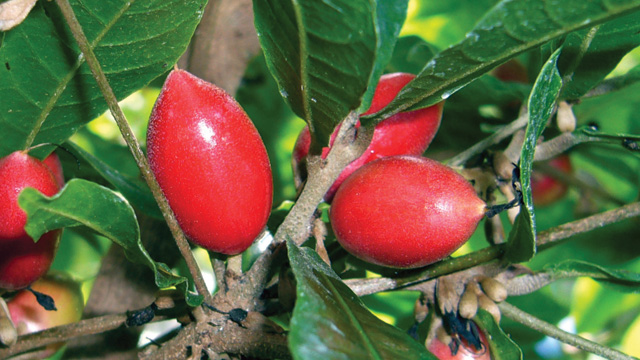
MAGIC BERRIES: The miracle fruit, synsepalum dulcificum, grows wild in tropical West Africa.SATOSHI OKUBO

Imagine sucking on a lemon that tastes as sweet as honey, or munching on what you think is a crunchy candy only to discover it’s a pickled onion. Such is the taste-bud trickery experienced at so-called flavor-tripping parties. The secret to the flavorful deceptions is a small red berry from West Africa called miracle fruit, which itself has very little flavor, but can make sour or acidic foods taste extremely sweet when eaten soon after the berry contacts the tongue. So bizarre is the fruit’s effect that just one taste was enough to convince Japanese food scientist Keiko Abe, of the University of Tokyo, to launch into an entirely new area of study.

In the early 1980s, Abe was researching oryzacystatin, the first recognized plant ...

Interested in reading more?

Become a Member of

The Scientist Logo
Receive full access to digital editions of The Scientist, as well as TS Digest, feature stories, more than 35 years of archives, and much more!
Already a member? Login Here

Related Topics

Meet the Author

  • ruth williams

    Ruth is a freelance journalist. Before freelancing, Ruth was a news editor for the Journal of Cell Biology in New York and an assistant editor for Nature Reviews Neuroscience in London. Prior to that, she was a bona fide pipette-wielding, test tube–shaking, lab coat–shirking research scientist. She has a PhD in genetics from King’s College London, and was a postdoc in stem cell biology at Imperial College London. Today she lives and writes in Connecticut.

    View Full Profile

Published In

Share
Illustration of a developing fetus surrounded by a clear fluid with a subtle yellow tinge, representing amniotic fluid.
January 2026

What Is the Amniotic Fluid Composed of?

The liquid world of fetal development provides a rich source of nutrition and protection tailored to meet the needs of the growing fetus.

View this Issue
Redefining Immunology Through Advanced Technologies

Redefining Immunology Through Advanced Technologies

Ensuring Regulatory Compliance in AAV Manufacturing with Analytical Ultracentrifugation

Ensuring Regulatory Compliance in AAV Manufacturing with Analytical Ultracentrifugation

Beckman Coulter Logo
Skip the Wait for Protein Stability Data with Aunty

Skip the Wait for Protein Stability Data with Aunty

Unchained Labs
Graphic of three DNA helices in various colors

An Automated DNA-to-Data Framework for Production-Scale Sequencing

illumina

Products

Sino Biological Logo

Sino Biological's Launch of SwiftFluo® TR-FRET Kits Pioneers a New Era in High-Throughout Kinase Inhibitor Screening

SPT Labtech Logo

SPT Labtech enables automated Twist Bioscience NGS library preparation workflows on SPT's firefly platform

nuclera logo

Nuclera eProtein Discovery System installed at leading Universities in Taiwan

Brandtech Logo

BRANDTECH Scientific Introduces the Transferpette® pro Micropipette: A New Twist on Comfort and Control










