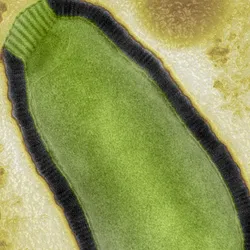
Electron microscopy image of Marburg virus false-colored red. 
| 3 min read
Marburg virus enters humans from bats to cause viral hemorrhagic fever, but how it alters immune cells is unclear.

bat

Bat perching upside down in a cave.

Some Bats Buzz Like Hornets to Deter Predators

A woman sits with a camera and recording equipment looking up at a tree full of bats (unseen).

Baby Talk: Bat Pups Babble Like Human Infants

When Pursuing Prey, Bats Tune Out the World

christmas island gold course australia extinct species Christmas Island forest skink Emoia nativitatis Christmas Island pipistrelle Pipistrellus murrayi

Australian Government Adds a Dozen Animals to Extinct List

Yunnan province, China, bats, bat, COVID-19, SARS-CoV-2, SARS-CoV-1, infectious disease, pandemic, coronavirus, climate change, modeling,

Are Climate-Driven Shifts in Bat Diversity to Blame for COVID-19?

wuhan china who world health organization sars-cov-2 origins lab escape huanan seafood market intermediate host bat covid-19 coronavirus pandemic

WHO Discounts Idea that SARS-CoV-2 Leaked from a Lab

Alterations in Immune Genes Make Bats Great Viral Hosts

a person with a basket strapped to her back walks past terraced rice fields

NIH Cancels Funding for Bat Coronavirus Research Project

bats hanging upside down

Where Coronaviruses Come From

Trending

A close-up image of a fly landing on a dessert

What Happens When a Fly Lands on Your Food? 

Photo of John Calhoun crouches within his rodent utopia-turned-dystopia

Universe 25 Experiment

Image of an infant’s feet that are visible in a hospital incubator.

Record-Breaking DNA Sequencing Technology Could Transform Newborn Care

A spooky stone mask sits against a black background.

Impersonation Scandals Shake Academic Publishing

Multimedia

Olga Anczukow and Ryan Englander discuss how transcriptome splicing affects immune system function in lung cancer.

Long-Read RNA Sequencing Reveals a Regulatory Role for Splicing in Immunotherapy Responses

Pacific Biosciences logo
Research Roundtable: The Evolving World of Spatial Biology

Research Roundtable: The Evolving World of Spatial Biology

Image of a woman with her hands across her stomach. She has a look of discomfort on her face. There is a blown up image of her stomach next to her and it has colorful butterflies and gut bacteria all swarming within the gut.
November 2025, Issue 1

Why Do We Feel Butterflies in the Stomach?

These fluttering sensations are the brain’s reaction to certain emotions, which can be amplified or soothed by the gut’s own “bugs".

View this Issue
Olga Anczukow and Ryan Englander discuss how transcriptome splicing affects immune system function in lung cancer.

Long-Read RNA Sequencing Reveals a Regulatory Role for Splicing in Immunotherapy Responses

Pacific Biosciences logo
Research Roundtable: The Evolving World of Spatial Biology

Research Roundtable: The Evolving World of Spatial Biology

Conceptual cartoon image of gene editing technology

Exploring the State of the Art in Gene Editing Techniques

Bio-Rad
Conceptual image of a doctor holding a brain puzzle, representing Alzheimer's disease diagnosis.

Simplifying Early Alzheimer’s Disease Diagnosis with Blood Testing

fujirebio logo

Products

Labvantage Logo

LabVantage Solutions Awarded $22.3 Million U.S Customs and Border Protection Contract to Deliver Next-Generation Forensic LIMS

The Scientist Placeholder Image

Evosep Unveils Open Innovation Initiative to Expand Standardization in Proteomics

OGT logo

OGT expands MRD detection capabilities with new SureSeq Myeloid MRD Plus NGS Panel