


Stay up to date on the latest science with Brush Up Summaries. This Brush Up is sponsored by Xiltrix.
With the advent of automation and digitization, the tools and technologies supporting research in the biological sciences are rapidly evolving. In this article, explore the transformative effects of new technologies on science laboratories.
Automation
One of the most impactful changes in modern research laboratories is the increased use of automation.1 Robotic devices can precisely and accurately conduct routine tasks such as pipetting, mixing, and measuring, which is especially helpful for high-throughput screening and next-generation sequencing experiments.
Automated instruments reduce the risk of human error and free researchers from repetitive manual tasks, reducing work-related injuries such as carpal tunnel and stiff neck syndrome.2 The introduction of automation increases result reproducibility and experimentation and data collection rates. With less time spent at the bench, scientists can dedicate themselves to greater intellectual pursuits.
AI-Powered Data Analysis
As experiments become more complex, the amount of output data also increases. Artificial intelligence (AI) algorithms help researchers analyze and interpret their data, identifying patterns and covert associations.3 Additionally, machine learning (ML) permits machines to “learn” features of datasets, allowing algorithms to adapt and make predictions.
Thus, AI can help automate data analysis, allowing investigators to work more efficiently and accurately. AI algorithms can identify outliers in large datasets or uncover new compounds. One specific example of how scientists currently use this approach is in improving sequence design for therapeutic mRNAs.4
Laboratory Connectivity
Interconnectivity between laboratory processes allows better asset, resource, and staff management. Monitoring, even remotely, of equipment such as incubators and freezers guarantees the protection of samples and experiments, ensures high-quality results, and permits regulatory compliance.
Furthermore, other lab equipment such as automated sequencers and data analysis software can directly send their output to electronic notebooks (ELNs), making traditional paper lab notebooks a thing of the past. Using digital notebooks, researchers easily edit results, find previous experiments, and compare data from related experiments. Moreover, ELNs produce consistent and comparable documentation, enabling researchers to readily share their data with collaborators.5
Data Digitalization
As data grows in volume and becomes more complex, storing it on local servers or hard drives is less practical. Cloud-based storage allows researchers to store their data securely and access it worldwide.6 This permits greater collaboration between researchers, as they can share data quickly and efficiently.
Alongside the increased availability of cloud storage options, concerns about privacy, confidentiality, and internet security are on the rise. This is especially true for ideas under patent and proprietary discoveries. To address these concerns, specialized encryption software is implemented across research institutes and workshops on confidentiality and data-sharing are held to educate researchers, making them aware of legislation, local regulations, and institute policies.
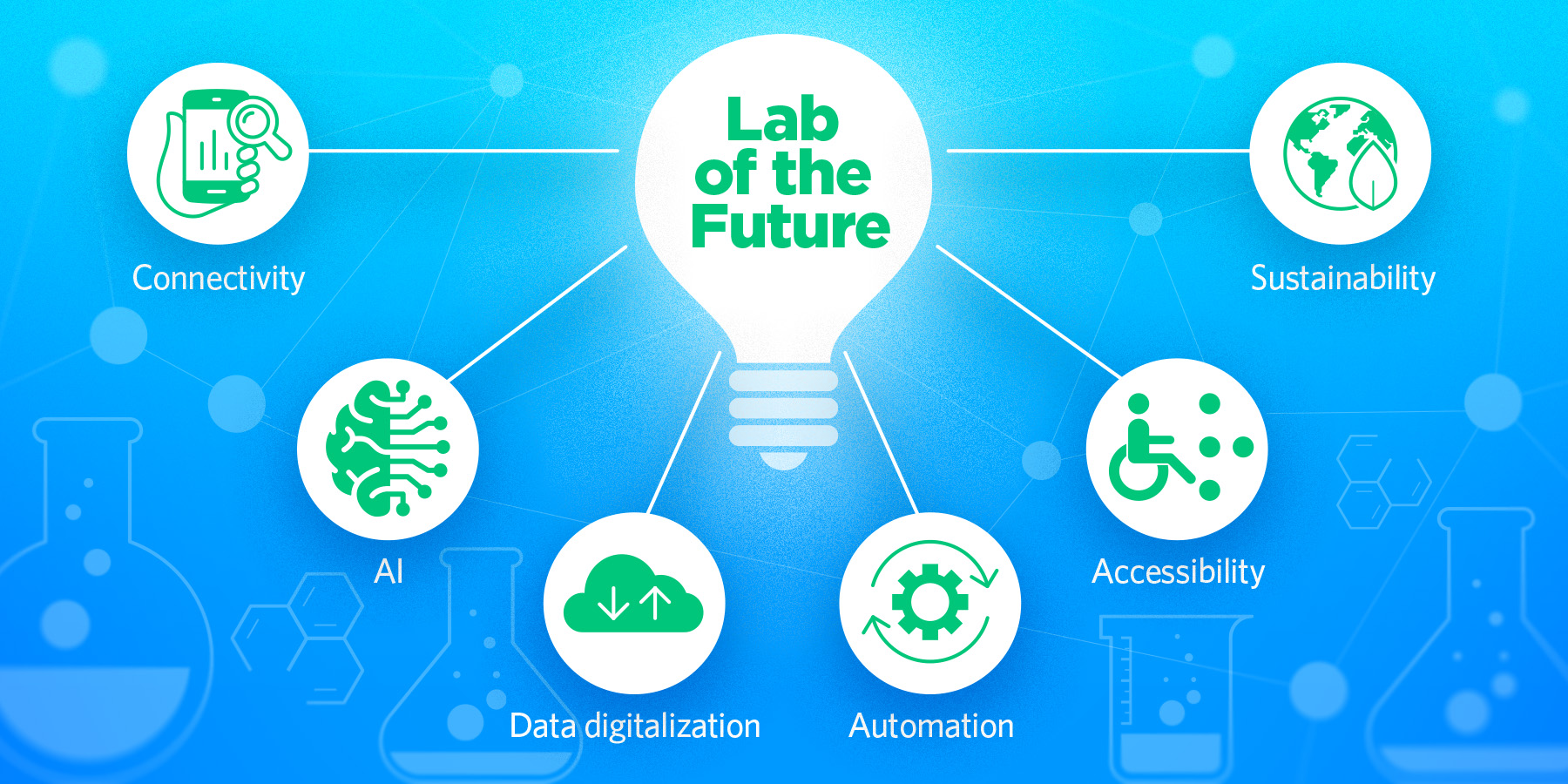
Sustainability
Laboratories have notoriously large carbon footprints. Single use plastics are extensively used and some experiments consume and generate hazardous substances. Extensive energy usage is also commonplace in laboratories as instruments run around the clock. Experts estimate that the energy needs of a median laboratory are triple that of an office space of the same size. Moreover, the plastic contribution is thought to be 2 percent of the world's total plastic waste.7
A paradigm shift is occurring, with energy-saving devices and better-maintained equipment and facilities becoming a priority. Additionally, laboratory suppliers are implementing bulk ordering, streamlined packaging, and package recycling, while plastic and toxic reagents are being substituted with eco-friendly counterparts, when available.8 The mindful disposal of waste is also rigorously enforced by institutes—laboratories often have a predesignated person responsible for waste disposal—further emphasizing the importance of laboratory sustainability.
Accessibility
Making research accessible for people with visible and invisible disabilities is another important consideration for laboratories going forward. To make this possible, multiple disciplines need to collaborate to make laboratories accessible for people with different needs.9
For example, older buildings should incorporate ramps and staircase lifts to aid those with certain physical disabilities, while new building designs should plan for these features from the start. Modular laboratory furniture should be made to accommodate all occupants, and alerts that are both auditory and visual should also be installed throughout the laboratory to keep all scientists safe in case of emergency.10 Additionally, automation reduces the necessity for hands-on work, while new accessibility software tools increase the inclusion of scientists with disabilities.11


- Hayase S, Katayama YA, Hatta T, et al. Near full automation of COPMAN using a LabDroid enables high-throughput and sensitive detection of SARS-CoV-2 RNA in wastewater as a leading indicator. Sci Total Environ. 2023;881:163454. doi:10.1016/j.scitotenv.2023.163454
2. El-Helaly M, Balkhy HH, Vallenius L. Carpal tunnel syndrome among laboratory technicians in relation to personal and ergonomic factors at work. J Occup Health. 2017;59(6):513-520. doi:10.1539/joh.16-0279-OA
3. Preto AJ, Matos-Filipe P, Mourão J, Moreira IS. SYNPRED: prediction of drug combination effects in cancer using different synergy metrics and ensemble learning. Gigascience. 2022;11:giac087. doi:10.1093/gigascience/giac087
4. Castillo-Hair SM, Seelig G. Machine learning for designing next-generation mRNA therapeutics. Acc Chem Res. 2022;55(1):24-34. doi:10.1021/acs.accounts.1c00621
5. Elberskirch L, Binder K, Riefler N, et al. Digital research data: from analysis of existing standards to a scientific foundation for a modular metadata schema in nanosafety. Part Fibre Toxicol. 2022;19(1):1. doi:10.1186/s12989-021-00442-x
6. Krumm N. Organizational and technical security considerations for laboratory cloud computing. J Appl Lab Med. 2023;8(1):180-193. doi:10.1093/jalm/jfac118
7. Farley M, Nicolet BP. Re-use of laboratory utensils reduces CO2 equivalent footprint and running costs. PLoS One. 2023;18(4):e0283697. doi:10.1371/journal.pone.0283697
8. Freeland B, McCarthy E, Balakrishnan R, et al. A review of polylactic acid as a replacement material for single-use laboratory components. Materials (Basel). 2022;15(9):2989. doi:10.3390/ma15092989
9. Bernard MA. Advancing disability inclusion in the scientific workforce | SWD at NIH. Science of diversity. Published July 21, 2021. Accessed May 26, 2023. https://diversity.nih.gov/blog/2021-07-21-advancing-disability-inclusion-scientific-workforce
10. Smith SB, Ross AD, Pagano T. Chemical and biological research with deaf and hard-of-hearing students and professionals: Ensuring a safe and successful laboratory environment. J Chem Health Saf. 2016;23(1):24-31. doi:10.1016/j.jchas.2015.03.002
11. Ellis LD. Designing accessible laboratory spaces for people with disabilities. Harvard T.H. Chan School of Public Health. Published June 14, 2021. Accessed May 26, 2023. https://www.hsph.harvard.edu/ecpe/designing-accessible-labs-for-people-with-disabilities/












