


This article won runner-up in our recent writing contest, "What's Your Story?". Congratulations to the author and thanks to everyone who took the time to read the stories and vote.

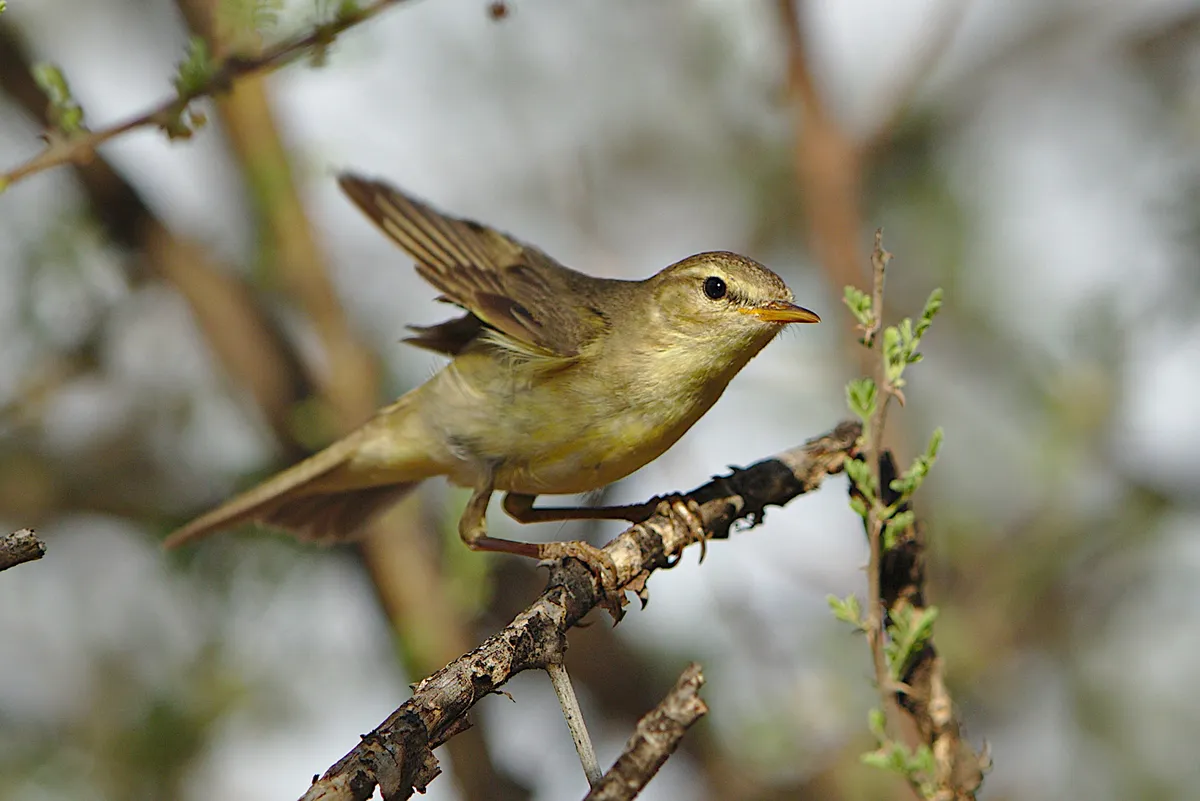
In the cold forests of Scandinavia, scientists are uncovering the mysteries of bird migration. Working with the willow warbler (Phylloscopus trochilus), a yellow bird the weight of a pencil, a team of biologists quantified how specific genetic variants determine the thousand-kilometer journey these birds make to Africa. They recently reported their findings in Nature Communications.1
Most small birds are solitary migrants, relying on a little understood behavioral program shown through captive breeding to be genetically determined and which can be induced experimentally in juveniles that have never migrated.2 As a rapidly changing climate threatens migratory birds3 by unsynchronizing migration and the springtime re-growth of vegetation, understanding how migration-associated genetic variation mediates adaptive responses could prove vital for conservation.

This missing link in migration studies puzzled many researchers, including Staffan Bensch and Kristaps Sokolovskis, evolutionary biologists at Lund University, who study two subspecies of willow warbler that breed in Sweden: P. t. trochilus migrates to West Africa, while P. t. acredula prefers winter destinations around the East and South of Africa, sometimes 10,000 kilometers from their birthplace.4 In Central Sweden, both subspecies occur and interbreed, producing hybrid offspring.5

To study migration in the hybrid birds, whose admixed genomes facilitate the association between genetics and traits, the team fitted individual tracking devices to 466 warblers across Sweden. “Our best bet was to tag as many birds in the hybrid zone as we could and hope we retrieve tracks from a decent number of hybrids,” said Sokolovskis, who recovered 72 birds after they returned from their African migration. Each bird’s tracker collected light level data, allowing scientists to reconstruct its geographical location throughout the year. The scientists then sequenced their DNA to answer how specific genetic variants identified in previous studies5,6 contributed to the hybrids’ migratory routes.

Bensch’s team found that alleles at just two genetic loci explained up to 74% of the total variation in the direction of migration. “When I first plotted the migratory routes … I was simply stunned. It was such an obvious pattern that running statistical tests seemed like a formality. I had to redo the graphs multiple times and triple check the data files to make sure it was real,” Sokolovskis said. One of these two loci harbors a chromosomal inversion that likely affects the expression of approximately 140 genes. However, 62% of the variance in direction was explained by a second, repetitive region of the genome whose presence largely overrides the inversion’s effects.
The researchers determined that if a willow warbler inherits this large repetitive block of DNA from an acredula parent, it will very likely be fixed into a route through Eastern Africa. This block may affect the expression of vital genes that control how willow warblers decide their routes and potentially how they perceive Earth’s magnetic field. “This study is very valuable, making a real connection between genotype and phenotype, contributing towards the general understanding of genetics behind migrations,” said Malgorzata Anna Gazda, an evolutionary genomicist at the University of Montréal.
When I first plotted the migratory routes … I was simply stunned.
- Kristaps Sokolovskis, Lund University
“Given changes in the environment, preserving genetic variation related to a key adaptation impacting birds’ fitness is crucial,” Gazda said. Populations that maintain the potential to explore alternative migratory strategies if faced with environmental changes may be the best placed to persist. “This knowledge gives some hope that at least some species may be able to rapidly start undertaking new migration routes if the ones they use currently become too perilous,” Sokolovskis said. For species that have neither the genetic variation nor a more flexible way to control their migration, their persistence may be at risk.











