Behavior Brief

A roundup of recent discoveries in behavior research

Written byJef Akst
| 5 min read

Register for free to listen to this article
Listen with Speechify
0:00
5:00
Share

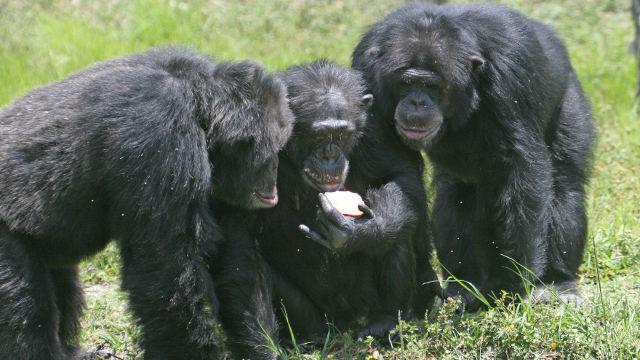
Three chimpanzees at Miami MetrozooWIKIMEDIA COMMONS, MATTHEW HOELSCHER

Socially-aware chimps

Wild chimps are more likely to call out in response to a poisonous snake when they are near another chimp that has not yet seen the trouble, according to a study published this week in Current Biology. Using plastic models of rhino and gaboon vipers—well-camouflaged snakes with deadly venom—researchers at the University of St. Andrews in Scotland saw that chimps first jumped away from the snakes, then approached it to investigate. At that point, they would make a soft "hoo" sound to alert other chimps, but only if there were other chimps nearby that were unaware of the snake.

“We monitored the snake all day, so we knew which animals had seen it and which hadn't,” lead author Catherine Crockford told BBC News. ...

Interested in reading more?

Become a Member of

The Scientist Logo
Receive full access to more than 35 years of archives, as well as TS Digest, digital editions of The Scientist, feature stories, and much more!
Already a member? Login Here

Related Topics

Meet the Author

  • Jef (an unusual nickname for Jennifer) got her master’s degree from Indiana University in April 2009 studying the mating behavior of seahorses. After four years of diving off the Gulf Coast of Tampa and performing behavioral experiments at the Tennessee Aquarium in Chattanooga, she left research to pursue a career in science writing. As The Scientist's managing editor, Jef edited features and oversaw the production of the TS Digest and quarterly print magazine. In 2022, her feature on uterus transplantation earned first place in the trade category of the Awards for Excellence in Health Care Journalism. She is a member of the National Association of Science Writers.

    View Full Profile
Share
Illustration of a developing fetus surrounded by a clear fluid with a subtle yellow tinge, representing amniotic fluid.
January 2026

What Is the Amniotic Fluid Composed of?

The liquid world of fetal development provides a rich source of nutrition and protection tailored to meet the needs of the growing fetus.

View this Issue
Human-Relevant In Vitro Models Enable Predictive Drug Discovery

Advancing Drug Discovery with Complex Human In Vitro Models

Stemcell Technologies
Redefining Immunology Through Advanced Technologies

Redefining Immunology Through Advanced Technologies

Ensuring Regulatory Compliance in AAV Manufacturing with Analytical Ultracentrifugation

Ensuring Regulatory Compliance in AAV Manufacturing with Analytical Ultracentrifugation

Beckman Coulter Logo
Skip the Wait for Protein Stability Data with Aunty

Skip the Wait for Protein Stability Data with Aunty

Unchained Labs

Products

Sino Biological Logo

Sino Biological's Launch of SwiftFluo® TR-FRET Kits Pioneers a New Era in High-Throughout Kinase Inhibitor Screening

SPT Labtech Logo

SPT Labtech enables automated Twist Bioscience NGS library preparation workflows on SPT's firefly platform

nuclera logo

Nuclera eProtein Discovery System installed at leading Universities in Taiwan

Brandtech Logo

BRANDTECH Scientific Introduces the Transferpette® pro Micropipette: A New Twist on Comfort and Control