Bones Won’t Be Buried Yet

Two 9,000-year-old skeletons will be held by University of California, San Diego, officials—rather than turned over to American Indians for reburial—until a lawsuit is settled.

Written byJef Akst
| 1 min read

Register for free to listen to this article
Listen with Speechify
0:00
1:00

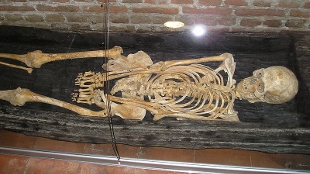
Grave in the NederlandsWIKIMEDIA COMMONS, VINCENT DE GROOT

The bones of two 9,000-year-old skeletons will remain above ground for at least a little while longer, thanks to a United States district court judge who signed an injunction this week (May 7) to extend a temporary restraining order keeping the bones in the custody of University of California, San Diego, officials until a case over the bones is settled, ScienceInsider reported.

For the past 6 years, since their discovery in 2006 during excavation of the UCSD chancellor’s home, the skeletons have been the center of a legal battle. The Kumeyaay Indians of San Diego want to rebury the bones, which they believe were unearthed from ancestral tribal lands, and filed a lawsuit this April to reclaim them. But three UCSC professors fought back, filing ...

Interested in reading more?

Become a Member of

The Scientist Logo
Receive full access to more than 35 years of archives, as well as TS Digest, digital editions of The Scientist, feature stories, and much more!
Already a member?
Add The Scientist as a preferred source on Google

Add The Scientist as a preferred Google source to see more of our trusted coverage.

Meet the Author

  • Jef (an unusual nickname for Jennifer) got her master’s degree from Indiana University in April 2009 studying the mating behavior of seahorses. After four years of diving off the Gulf Coast of Tampa and performing behavioral experiments at the Tennessee Aquarium in Chattanooga, she left research to pursue a career in science writing. As The Scientist's managing editor, Jef edited features and oversaw the production of the TS Digest and quarterly print magazine. In 2022, her feature on uterus transplantation earned first place in the trade category of the Awards for Excellence in Health Care Journalism. She is a member of the National Association of Science Writers.

    View Full Profile

Related Topics

The Scientist Digest cover September 2026
September 2026

Multiplex Microscopy Becomes Easier with Encoded Antibodies

A new system that enables researchers to uniquely tag monoclonal antibodies for use in microscopy could help simplify complex imaging studies.

View this Issue
Rethinking ALS Biomarkers: From Discovery to Clinical Impact

Rethinking ALS Biomarkers: From Discovery to Clinical Impact

Alamar Biosciences logo
Best Practices for qPCR Assay Design and Optimization

Best Practices for qPCR Assay Design and Optimization

Bio-Rad
Beyond the Basics: Strategies for Single-Cell and Spatial Transcriptomics Analysis

Beyond the Basics: Strategies for Single-Cell and Spatial Transcriptomics Analysis

bioxcell
Scientist reviewing cellular and molecular data on a computer in a laboratory.

Building Translation-Ready Biomarkers with Connected Workflows

Danaher Logo

Products

Closeup image of a multi channel pipette dispensing pink liquid into a 96-well plate.

The ASSIST PLUS pipetting robot for affordable workflow automation

Integra Logo
Single cells in suspension

Rapidly isolate primary cells and make uniform single-cell suspensions with Corning® Cell Strainers

Corning logo
Abstract image representing cell membranes linked together.

CellBrite® Steady Membrane Stain: Cell surface staining built for real-time imaging

Biotium
sino biological logo

Monod Bio Licenses AI-designed Protein Technologies to SignalChem Biotech for Custom Discovery Assays










