


Axons are the brain’s information highways, transporting cellular cargo, chemical signals, and electrical impulses to other cells. These “roads” are typically depicted as smooth and cylindrical, with occasional bulges that store and release neurotransmitters, extending from the amoeba-like neural body. However, axons can also adopt a pearled shape, which typically becomes more pronounced as axons degrade in neurodegenerative diseases.
But new research by Shigeki Watanabe, a molecular neuroscientist at Johns Hopkins University, indicates that this shapeshifting may not always be pathological. Watanabe first noticed axon pearling in healthy Caenorhabditis elegans neurons as a graduate student at the University of Utah, though he didn’t pursue it further at the time.1 Then, in 2019, Watanabe started a conversation with fellow neuroscientist and collaborator Graham Knott at the Swiss Federal Technology Institute of Lausanne; Knott had observed the same phenomenon in mouse brain slices.
Together, Watanabe and Knott began studying the relationship between form and function in unmyelinated axons, which tend to exhibit more irregular shapes compared to the consistent cylindrical structure of myelinated axons. Watanabe and his team used electron microscopy to examine unmyelinated axons in mice and determine whether the pearled pattern was the natural axon shape.

Their findings, published in Nature Neuroscience, contrast with the classical view of tubular axons.2 The researchers propose that this shape is a ubiquitous feature in all unmyelinated axons; furthermore, they hypothesize that these pearls are influenced by properties of the axon membrane, such as tension, which affects how neurons fire electrical signals.
Watanabe began his investigation by exploring the underlying mechanism that shaped these pearl-like structures. Since his initial experiments in graduate school, other groups had described how actin formed a repeating "skeletal" structure within the axon.3 “These actin rings along the axons are much like a vacuum hose and make it so that the axon can move around without breaking,” explained Watanabe. Noting the structural similarities between these rings and the pearls, Watanabe hypothesized that disrupting the actin rings might eliminate the pearl-like formations—but to his surprise, this was not the case.
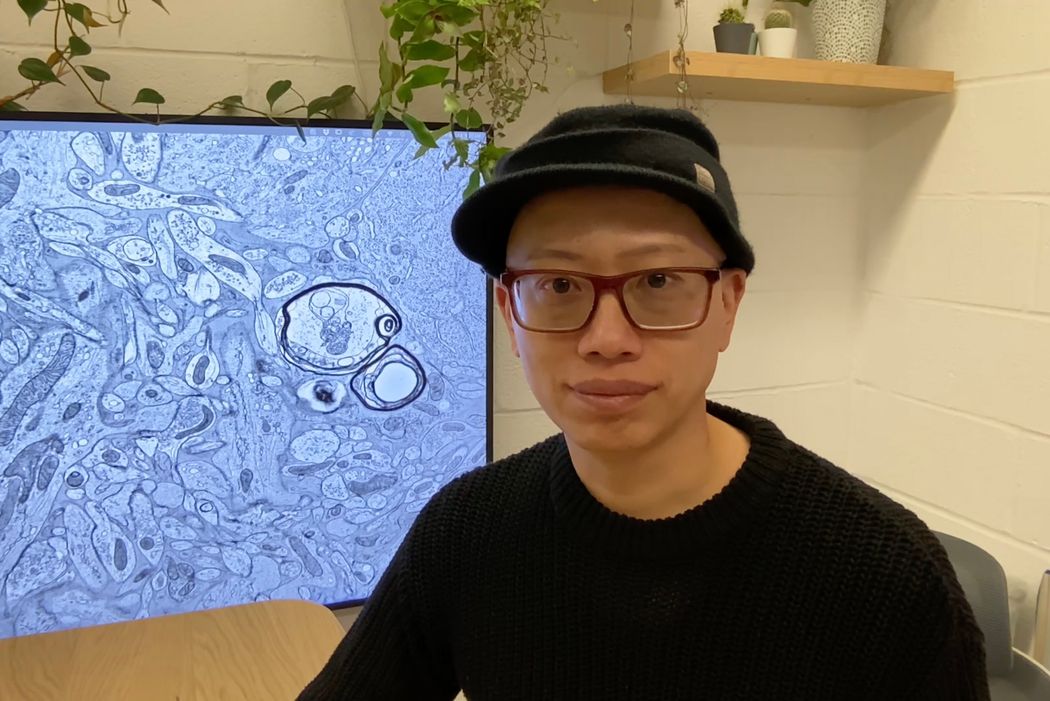
Shigeki Watanabe studies axon morphology with innovative electron microscopy techniques.
Shigeki Watanabe
Next, Watanabe and his team took a closer look at the axons’ physical properties with electron microscopy. Ultrastructural analysis often relies on aldehyde-based fixation, which dehydrates tissue, shrinking it in the same way that a grape turns into a raisin. To preserve the delicate morphology, Watanabe employed high-pressure freezing—a technique he had previously used to study axons in C. elegans.4 The researchers examined three types of mouse neurons: ones grown in the lab, those taken from adult mice, and those taken from mouse embryos. These neurons were unmyelinated and each axon displayed distinct pearls which were spaced 200 nanometers (nm) apart along an axon with a diameter of 60nm. The researchers also observed these pearls during live neuron imaging.
But what caused this distinct pearl-like shape? Watanabe and his team hypothesized that plasma membrane properties played a role. They conducted a series of experiments using mathematical models and samples from mouse hippocampal and cortical neurons. The researchers tested various conditions, such as exposure to hyper- or hypo-tonic solutions and the removal of cholesterol, which is linked to membrane rigidity. “The first thing we tried was essentially changing the osmotic pressure in the accessible space, and that altered the morphology,” Watanabe explained. “At that point, we [believed] we were onto something.”
Their findings revealed that osmotic pressure played a significant role in shaping the pearl-like structures: High osmotic pressure reduced their size and spacing, and low osmolarity had the opposite effect. Additionally, removing cholesterol from the neuron’s membrane made it less stiff and more fluid-like, altering the axon’s shape and reducing pearling.

Based on these results, Watanabe set out to test whether this form dictated the function of the axon, focusing on the interaction between pearling and sodium channel placement, which is critical for generating action potentials and firing electrical signals. Watanabe remarked that previous studies “assumed that axons were cylindrical, and it didn’t matter where the [sodium] channels were.” His team ran simulations to test how sodium channel placement influenced action potential firing in both cylindrical and pearled axons. Although firing speed remained unchanged in cylindrical axons, pearled axons showed faster action potentials when sodium channels were periodically spaced at 190nm.
Next, the researchers tested the neurons’ ability to conduct electrical signals in mouse neurons. They found that altering the typical pearled structure—such as reducing the spacing between pearls or decreasing membrane rigidity by removing cholesterol—slowed action potential firing. Conversely, pearls spaced farther apart allowed for faster signal conduction, emphasizing the impact of structural dynamics on neuronal performance.
Adam Cohen, a chemical biologist at Harvard University who was not involved in the research, remarked that while pearling is not a new phenomenon, the team’s observation of this pattern in neurons under non-pathological conditions is particularly intriguing. “This paper is a vivid reminder that the brain is a physical object and that its function is constrained by the properties of this wet, squishy, and stretchy material,” said Cohen. “Because of its sort of physicality, that provides opportunities for new ways of regulating signal propagation.”
Watanabe mentioned that ongoing research aims to explore whether these patterns are also present in human neurons, both in vitro and in vivo.5 Additionally, he is curious about what happens to axon morphology during sleep, when changes in fluid dynamics alter the membrane mechanics of neurons, helping them clear waste.

- Jurrus E, et al. Semi-automated neuron boundary detection and nonbranching process segmentation in electron microscopy images.Neuroinform. 2013;11:5-29.
- Griswold JM, et al. Membrane mechanics dictate axonal pearls-on-a-string morphology and function. Nat Neurosci. 2024;28:49-61.
- Xu K, et al. Actin, spectrin, and associated proteins form a periodic cytoskeletal structure in axons. Science. 2013;339(6118):452-456.
- Watanabe S. Flash-and-freeze: Coordinating optogenetic stimulation with rapid freezing to visualize membrane dynamics at synapses with millisecond resolution. Front Synaptic Neurosci. 2016;8:24.
- Eddings CR, et al. Ultrastructural membrane dynamics of mouse and human cortical synapses. bioRxiv. 2024.12.26.630393.











