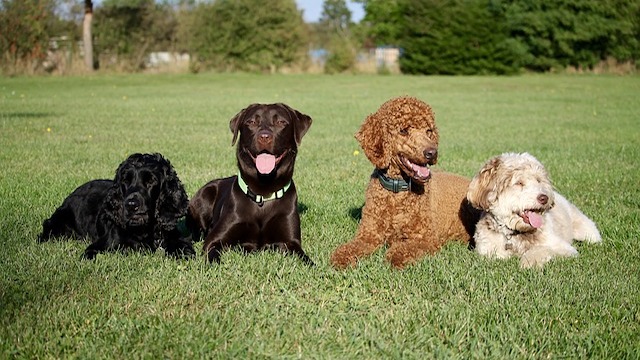
Genetic Analysis Reveals the Evolutionary History of Dogs

By analyzing the genomes of 161 dog breeds, scientists discover how and when certain canine breeds emerged.

Written byDiana Kwon
| 2 min read

Register for free to listen to this article
Listen with Speechify
0:00
2:00

PIXABAY, KATRINBECHTEL

Domestic dogs (Canis familiaris) have lived alongside humans for thousands of years. An extensive genetic analysis, published this week (April 25) in Cell Reports, now sheds light on the roles that factors like migration and breeding likely played in canine evolution.

“Each time we come up with different changes into our own sort of society and the way we live, then there’s room for a new kind of dog, or a new shape, a new size,” coauthor Heidi Parker, a dog geneticist at the US National Institutes of Health, told The Verge.

Park and colleagues assessed the genomes of 1,346 dogs across 161 breeds to assemble an extensive family tree, outlining the canines’ evolutionary histories. The team’s analysis revealed that the 161 dog breeds fell ...

Interested in reading more?

Become a Member of

The Scientist Logo
Receive full access to more than 35 years of archives, as well as TS Digest, digital editions of The Scientist, feature stories, and much more!
Already a member?
Add The Scientist as a preferred source on Google

Add The Scientist as a preferred Google source to see more of our trusted coverage.

Meet the Author

  • Diana is a freelance science journalist who covers the life sciences, health, and academic life. She’s a regular contributor to The Scientist and her work has appeared in several other publications, including Scientific American, Knowable, and Quanta. Diana was a former intern at The Scientist and she holds a master’s degree in neuroscience from McGill University. She’s currently based in Berlin, Germany.

    View Full Profile

Related Topics

Related articles background image
The Scientist Digest cover September 2026
September 2026

Multiplex Microscopy Becomes Easier with Encoded Antibodies

A new system that enables researchers to uniquely tag monoclonal antibodies for use in microscopy could help simplify complex imaging studies.

View this Issue
Rethinking ALS Biomarkers: From Discovery to Clinical Impact

Rethinking ALS Biomarkers: From Discovery to Clinical Impact

Alamar Biosciences logo
Best Practices for qPCR Assay Design and Optimization

Best Practices for qPCR Assay Design and Optimization

Bio-Rad
Beyond the Basics: Strategies for Single-Cell and Spatial Transcriptomics Analysis

Beyond the Basics: Strategies for Single-Cell and Spatial Transcriptomics Analysis

bioxcell
Scientist reviewing cellular and molecular data on a computer in a laboratory.

Building Translation-Ready Biomarkers with Connected Workflows

Danaher Logo

Products

Closeup image of a multi channel pipette dispensing pink liquid into a 96-well plate.

The ASSIST PLUS pipetting robot for affordable workflow automation

Integra Logo
Single cells in suspension

Rapidly isolate primary cells and make uniform single-cell suspensions with Corning® Cell Strainers

Corning logo
Abstract image representing cell membranes linked together.

CellBrite® Steady Membrane Stain: Cell surface staining built for real-time imaging

Biotium
sino biological logo

Monod Bio Licenses AI-designed Protein Technologies to SignalChem Biotech for Custom Discovery Assays