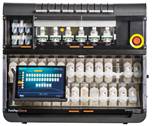
Gyros Protein Technologies introduces PurePep Chorus automated peptide synthesizer

  • Flexible, modular system, designed for 21CFR Part 11 compliance
  • Delivers high purity, productivity and yield for simple to complex peptides

Brought to you byGyros Protein Technologies
| 2 min read

Register for free to listen to this article
Listen with Speechify
0:00
2:00

Gyros Protein Technologies AB, a pioneer in automated nanoliter-scale immunoassay platforms and leading provider of peptide synthesizers and reagents, today introduced PurePep™ Chorus, its next generation automated peptide synthesis platform. The new scalable instrument and software platform enables production of even the most challenging sequences at the highest possible crude purity and yield.

Scientists using peptides in development of novel therapeutics, biological research, or biomaterials development frequently work on long and difficult sequences, including modified cyclic peptides. These are particularly challenging to synthesize at sufficiently high purity and yield, and often require precious or expensive reagents.

Designed to overcome these issues and make these advancements accessible to both academic and industrial scientists, PurePep Chorus has a modular design, enabling in-lab upgrades aligned with the growing needs of peptide researchers. The flexible system can be purchased with, or lab-upgraded to include, two, four, or six channels, with independent induction heating, and ...

Interested in reading more?

Become a Member of

The Scientist Logo
Receive full access to more than 35 years of archives, as well as TS Digest, digital editions of The Scientist, feature stories, and much more!
Already a member?
Add The Scientist as a preferred source on Google

Add The Scientist as a preferred Google source to see more of our trusted coverage.

Related articles background image
The Scientist Digest cover September 2026
September 2026

Multiplex Microscopy Becomes Easier with Encoded Antibodies

A new system that enables researchers to uniquely tag monoclonal antibodies for use in microscopy could help simplify complex imaging studies.

View this Issue
Rethinking ALS Biomarkers: From Discovery to Clinical Impact

Rethinking ALS Biomarkers: From Discovery to Clinical Impact

Alamar Biosciences logo
Best Practices for qPCR Assay Design and Optimization

Best Practices for qPCR Assay Design and Optimization

Bio-Rad
Beyond the Basics: Strategies for Single-Cell and Spatial Transcriptomics Analysis

Beyond the Basics: Strategies for Single-Cell and Spatial Transcriptomics Analysis

bioxcell
Scientist reviewing cellular and molecular data on a computer in a laboratory.

Building Translation-Ready Biomarkers with Connected Workflows

Danaher Logo

Products

Closeup image of a multi channel pipette dispensing pink liquid into a 96-well plate.

The ASSIST PLUS pipetting robot for affordable workflow automation

Integra Logo
Single cells in suspension

Rapidly isolate primary cells and make uniform single-cell suspensions with Corning® Cell Strainers

Corning logo
Abstract image representing cell membranes linked together.

CellBrite® Steady Membrane Stain: Cell surface staining built for real-time imaging

Biotium
sino biological logo

Monod Bio Licenses AI-designed Protein Technologies to SignalChem Biotech for Custom Discovery Assays






