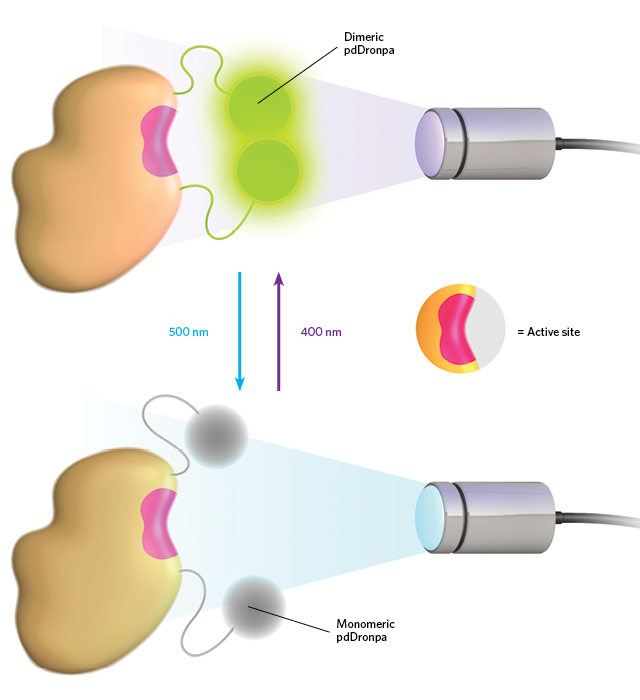
Infographic: Enzymes Controlled by Light

Custom-designed kinases have built-in switches that act as gatekeepers for the enzymes' active sites.

Written byRuth Williams
| 1 min read

Register for free to listen to this article
Listen with Speechify
0:00
1:00

© GEORGE RETSECK

Researchers have designed kinases that can be inactivated and activated by light. In violet light, engineered green fluorescent domains (called pdDronpa) dimerize, glow, and block the enzyme’s active site (top). In blue light, the domains break into monomers, lose their fluorescence, and uncage the kinase’s active site (bottom).

Read the full story.

Interested in reading more?

Become a Member of

The Scientist Logo
Receive full access to more than 35 years of archives, as well as TS Digest, digital editions of The Scientist, feature stories, and much more!
Already a member?
Add The Scientist as a preferred source on Google

Add The Scientist as a preferred Google source to see more of our trusted coverage.

Meet the Author

  • ruth williams

    Ruth is a freelance journalist. Before freelancing, Ruth was a news editor for the Journal of Cell Biology in New York and an assistant editor for Nature Reviews Neuroscience in London. Prior to that, she was a bona fide pipette-wielding, test tube–shaking, lab coat–shirking research scientist. She has a PhD in genetics from King’s College London, and was a postdoc in stem cell biology at Imperial College London. Today she lives and writes in Connecticut.

    View Full Profile

Related Topics

Related articles background image
August 2026 Digest cover
August 2026

Epic Fail: Sea-Monkeys Sabotage Fieldwork

When Barry Hicks set out to photograph thrombolites, thousands of unexpected visitors photobombed his underwater images.

View this Issue
Improving rAAV Production for Viral Vector Manufacturing

Improving rAAV Production for Viral Vector Manufacturing

cytiva logo
Advancing Respiratory Immunity Through Tissue-Resident Memory T Cell Research

Advancing Respiratory Immunity Through Tissue-Resident Memory T Cell Research

Miltenyi
Scientist holding a clear 384-well PCR microplate in a laboratory

What Dictates PCR Success Before Amplification Begins?

Integra Logo
Overcoming Immunotherapy Resistance in Liver Cancer

Overcoming Immunotherapy Resistance in Liver Cancer

Axion Biosystems

Products

Sino Biological Logo

Sino Biological Launches European Newsletter Campaign with Exclusive Welcome Gifts

Sino Biological Logo

Sino Biological Launches SuperNuclease ® Pro with Free Trial Program

Sino Biological Logo

Sino Biological Launches Precisely Characterized Full-Length p-Tau217 Protein to Advance Next-Generation Alzheimer’s Biomarker Assay Development

A photo of a scientist placing the Resipher device on a 96-well plate.

Resipher: Continuous Live-Cell Mitochondrial Respiration Monitoring in 96-Well Plates

Lucid Scientific logo