

 © GEORGE RETSECK
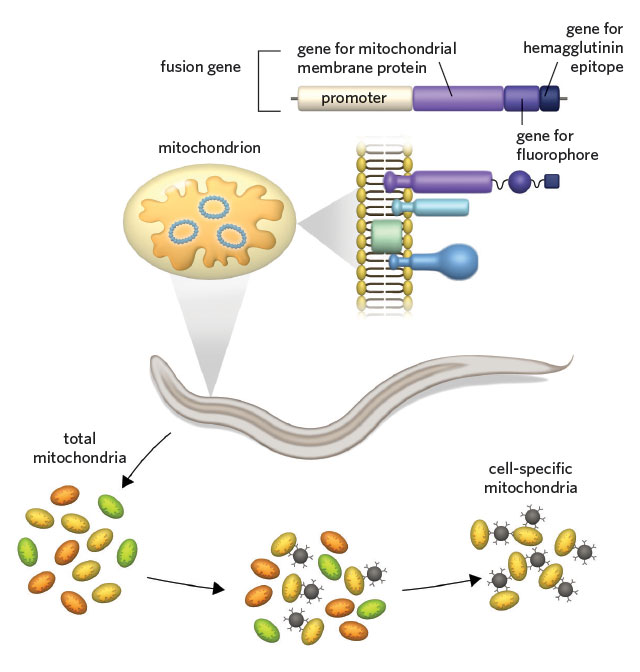
With CS-MAP, researchers genetically label mitochondria in cells of interest, then use antibodies to isolate them for analysis.
Adding a fusion gene to certain mitochondria in C. elegans enables researchers to collect and analyze them.
© GEORGE RETSECK
With CS-MAP, researchers genetically label mitochondria in cells of interest, then use antibodies to isolate them for analysis.


Ruth is a freelance journalist. Before freelancing, Ruth was a news editor for the Journal of Cell Biology in New York and an assistant editor for Nature Reviews Neuroscience in London. Prior to that, she was a bona fide pipette-wielding, test tube–shaking, lab coat–shirking research scientist. She has a PhD in genetics from King’s College London, and was a postdoc in stem cell biology at Imperial College London. Today she lives and writes in Connecticut.
View Full ProfileWhen experiments refuse to cooperate, you try again and again. For Rafael Najmanovich, the setbacks ultimately pushed him in a new direction.
View this Issue
In this half-day virtual summit, a series of presentations will explore the scientific, regulatory, and operational factors impacting the use of in vitro NAMs in drug discovery.


In this webinar, scientists will discuss innovations that are unlocking new insights into immunity.

In this webinar, Magdalena Pacewicz will highlight how to use AUC to characterize AAVs as part of ensuring regulatory compliance.


Discover how the latest cancer research models and their applications help scientists pursue breakthrough cancer therapy research.


Chief Business Officer Dr. Rob Burgess Shares How Sino Biological Is Empowering Global Biomedical Research Through Precision, Quality, and Innovation on an Exclusive Segment on Fox Business Network airing on February 1, 2026 at 4:30pm EST

Sino Biological, Inc. has announced the accelerated availability and development of critical research tools to support the global scientific community in combating NiV.

Collaboration will bring next generation orchestration and modular automation to scientists worldwide

The ranking places Refeyn among a cohort of high-growth UK technology firms spanning sectors including the life sciences, energy and sustainability, telecommunications, and digital technology.
