Mighty Modifications

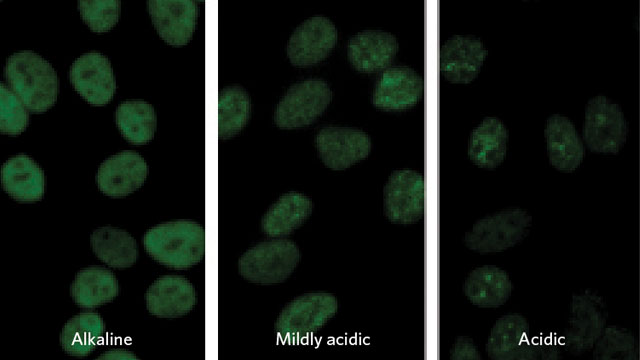
Histone acetylation levels keep intracellular pH in check.

Written byBeth Marie Mole
| 2 min read

Register for free to listen to this article
Listen with Speechify
0:00
2:00
Share

HISTONE pH: As the pH of media decreases from alkaline to acidic, global histone acetylation (green) in HeLa cells diminishes.COURTESY OF MATTHEW MCBRIAN AND SIAVASH KURDISTANI

The Paper
M.A. McBrian et al., “Histone acetylation regulates intracellular pH,” Mol Cell, 49:310-21, 2013.

The problem Genome-wide levels of histone acetylation—the epigenetic process commonly associated with upregulated local gene expression—are dynamic and can vary widely among cells in different tissues and in tumors. Moreover, scientists have linked low global histone acetylation levels in cancer cells to poor clinical outcomes. Siavash Kurdistani and colleagues at the University of California, Los Angeles, wanted to know what causes these differences and what they mean for the cell. The formula Kurdistani and colleagues started tweaking all the components of cell culture media to see what factors might affect acetylation levels. When they lowered the pH of the media, resulting in lower intracellular pH, the global acetylation level also ...

Interested in reading more?

Become a Member of

The Scientist Logo
Receive full access to digital editions of The Scientist, as well as TS Digest, feature stories, more than 35 years of archives, and much more!
Already a member? Login Here
Illustration of a developing fetus surrounded by a clear fluid with a subtle yellow tinge, representing amniotic fluid.
January 2026, Issue 1

What Is the Amniotic Fluid Composed of?

The liquid world of fetal development provides a rich source of nutrition and protection tailored to meet the needs of the growing fetus.

View this Issue
Skip the Wait for Protein Stability Data with Aunty

Skip the Wait for Protein Stability Data with Aunty

Unchained Labs
Graphic of three DNA helices in various colors

An Automated DNA-to-Data Framework for Production-Scale Sequencing

illumina
Exploring Cellular Organization with Spatial Proteomics

Exploring Cellular Organization with Spatial Proteomics

Abstract illustration of spheres with multiple layers, representing endoderm, ectoderm, and mesoderm derived organoids

Organoid Origins and How to Grow Them

Thermo Fisher Logo

Products

Brandtech Logo

BRANDTECH Scientific Introduces the Transferpette® pro Micropipette: A New Twist on Comfort and Control

Biotium Logo

Biotium Launches GlycoLiner™ Cell Surface Glycoprotein Labeling Kits for Rapid and Selective Cell Surface Imaging

Colorful abstract spiral dot pattern on a black background

Thermo Scientific X and S Series General Purpose Centrifuges

Thermo Fisher Logo
Abstract background with red and blue laser lights

VANTAstar Flexible microplate reader with simplified workflows

BMG LABTECH










