Human longing for longevity is universal. Across cultures, mythological stories about elixirs of immortality exist, highlighting a common desire to stay youthful forever. The concept of immortality remains a distant dream, but one jellyfish species embodies it. This cnidarian goes through the different life cycle stages like any other species of its kind, but when an adult experiences stress, it reverts to a juvenile stage. Imagine how convenient life would be if, instead of having to worry about the negative impact of stress on your health, you could just reset to your teen years. It’s no surprise that researchers are investigating this jellyfish to tap into its longevity secrets. If you are curious about their progress, you will find the answers in our feature story about this “immortal” jellyfish.
The jellyfish’s peculiar anti-aging strategy got me thinking about human aging. Aging is not a disease—rather, it’s a privilege—but the odds of contracting diseases, particularly neurological disorders, stack up against us with age. For instance, dementia affects about one in 10 Americans aged 65 or more. Needless to say, understanding age-related neurological disorders is an integral part of aging research. Many studies focus on the proteins that go haywire in the brain, so that’s something I often read about. But recently I learned about a unique concept: Uri Manor, a scientist at the University of California, San Diego, suspects that hearing loss could be an early indicator of dementia. Manor, who studies inner ear hair cells, mentioned that these cells make only 15 synapses with downstream neurons, compared to the thousands in the brain. So, if an individual is losing synapses over time, it’s noticeable in the ear much earlier than in the brain. The discussion was a light-bulb moment for me: One of my grandparents suffered from partial memory loss as they aged, but they had lost their hearing several years before. Although it’s an anecdotal drop in a sea of data, I find the rare occasions where science becomes personal rather special. Even as researchers try to better understand these connections, just knowing that there are so many different threads to pull on in these complex diseases gives me hope that one or more of these might help unravel a solution. If you perked up on reading about the hearing loss-dementia connection, you can read about this work in detail in Manor’s profile article in this issue.
The mind remains shrouded in mystery; we can only hope it syncs with the right beats.
—Meenakshi Prabhune, The Scientist
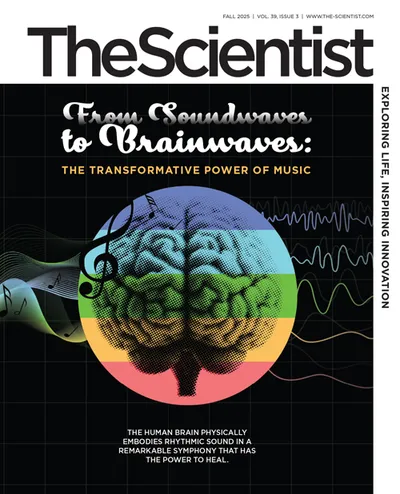
Interestingly, the sound-brain connection doesn’t end there. Music is more than an auditory stimulus to the brain: In fact, the brain responds to rhythm and synchronizes its own pulses with music beats. Researchers have successfully tapped into music to unlock lost abilities for those suffering from neurological damage: People who had speech or mobility issues after a stroke could talk and walk better to a beat. But how exactly does music affect the brain? Tune into our cover feature story to read about the neural symphonies.
As always, there is a lot more to learn about brain health and aging. The mind remains shrouded in mystery; we can only hope it syncs with the right beats.