


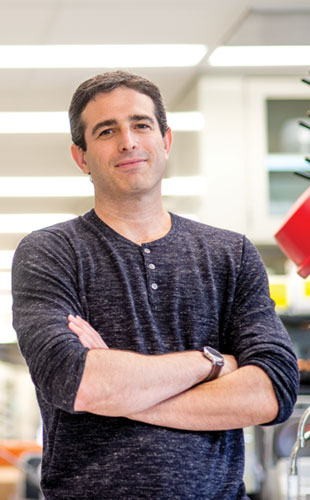
 © MATTHEW GILSONGrowing up in the town of Beersheba in Israel, Yoav Gilad became restless when high school failed to challenge him. So, after testing out of his classes and graduating early, he started taking college courses at age 15, eventually matriculating at Ben-Gurion University his hometown, where he majored in molecular genetics and biochemistry. “I was fascinated by the contrast between the fact that so much is planned and programmed, but there’s also so much variability,” Gilad recalls.
Mandatory army service sidelined his college career for three years, but Gilad eventually returned to Ben-Gurion, where he got his first taste of laboratory research near the end of his undergraduate tenure. Gilad says he was captivated by the idea that through laboratory science he could potentially become the first person in the world to find the answers to age-old questions. “The charm of that really attracted me,” he says. METHODS: Near the end of his army service, Gilad met geneticist Doron Lancet, who, as part of his reserve duty, occasionally lectured to troops about genetics and the origin of life. Three years later, when Gilad applied to graduate school at the Weizmann Institute of Science, he looked up Lancet, who not only remembered the ...












