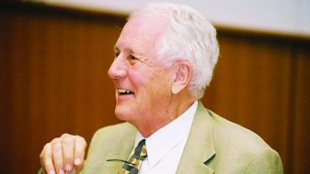
Bioluminescence Researcher Dies

Harvard biochemist J. Woodland Hastings, who first theorized about quorum sensing in the late 1960s, succumbed to pulmonary fibrosis last week at age 87.

Written byJef Akst
| 2 min read

Register for free to listen to this article
Listen with Speechify
0:00
2:00

WIKIMEDIA, NIH, TINSLEY DAVISJ. Woodland “Woody” Hastings, whose work on the luminescent marine bacterium Vibrio fischeri led to the characterization of quorum sensing, died last week (August 6) in his home in Lexington, Massachusetts. The cause was pulmonary fibrosis, according to his family; he was 87.

When Hastings and his colleague Kenneth Nealson first uncovered evidence in the late 1960s that V. fischeri could communicate with one another, only producing the bioluminescence once their population reached certain concentrations, the scientific community was skeptical. In fact, quorum sensing, as it came to be known, was not accepted until nearly 20 years later, when researchers identified the molecule that allowed the bacteria to sense the concentration of their community. And it was another decade before quorum sensing was recognized as a widespread bacterial phenomenon.

“One of Woody’s great fortes was coming up with concepts,” Nealson, an environmental science professor at the University of Southern California, told The New York Times. “He would see things other people wouldn’t see.”

Hastings began his work on ...

Interested in reading more?

Become a Member of

The Scientist Logo
Receive full access to more than 35 years of archives, as well as TS Digest, digital editions of The Scientist, feature stories, and much more!
Already a member?
Add The Scientist as a preferred source on Google

Add The Scientist as a preferred Google source to see more of our trusted coverage.

Meet the Author

  • Jef (an unusual nickname for Jennifer) got her master’s degree from Indiana University in April 2009 studying the mating behavior of seahorses. After four years of diving off the Gulf Coast of Tampa and performing behavioral experiments at the Tennessee Aquarium in Chattanooga, she left research to pursue a career in science writing. As The Scientist's managing editor, Jef edited features and oversaw the production of the TS Digest and quarterly print magazine. In 2022, her feature on uterus transplantation earned first place in the trade category of the Awards for Excellence in Health Care Journalism. She is a member of the National Association of Science Writers.

    View Full Profile

Related Topics

Related articles background image
August 2026 Digest cover
August 2026

Epic Fail: Sea-Monkeys Sabotage Fieldwork

When Barry Hicks set out to photograph thrombolites, thousands of unexpected visitors photobombed his underwater images.

View this Issue
Advancing Respiratory Immunity Through Tissue-Resident Memory T Cell Research

Advancing Respiratory Immunity Through Tissue-Resident Memory T Cell Research

Miltenyi
Overcoming Immunotherapy Resistance in Liver Cancer

Overcoming Immunotherapy Resistance in Liver Cancer

Axion Biosystems
Optimizing NGS Library Preparation for Reliable Sequencing Data

Optimizing NGS Library Preparation for Reliable Sequencing Data

Covaris
Using TCR Repertoire Sequencing to Advance Immunology Research

Using TCR Repertoire Sequencing to Advance Immunology Research

Miltenyi

Products

Sino Biological Logo

Sino Biological Launches European Newsletter Campaign with Exclusive Welcome Gifts

Sino Biological Logo

Sino Biological Launches SuperNuclease ® Pro with Free Trial Program

Sino Biological Logo

Sino Biological Launches Precisely Characterized Full-Length p-Tau217 Protein to Advance Next-Generation Alzheimer’s Biomarker Assay Development

A photo of a scientist placing the Resipher device on a 96-well plate.

Resipher: Continuous Live-Cell Mitochondrial Respiration Monitoring in 96-Well Plates

Lucid Scientific logo










