Birds Possess an Innate Vocal Signature Based on Silent Gaps

Zebra finches reared by another species learn to sing their foster parents’ song with rhythms characteristic of their genetic background.

Written byDiana Kwon
| 2 min read

Register for free to listen to this article
Listen with Speechify
0:00
2:00
Share

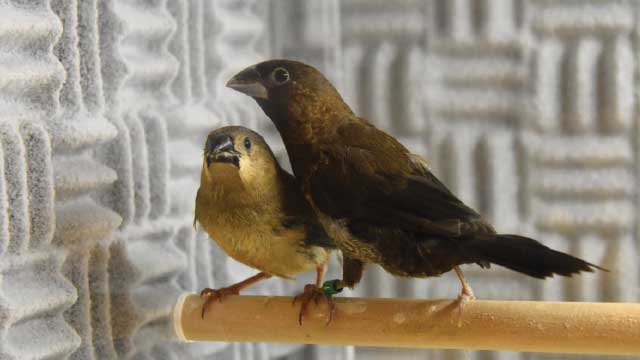
VOCAL COACH: A zebra finch (left) learned to sing from its foster parent, a Bengalese finch (right). OKINAWA INSTITUTE OF SCIENCE AND TECHNOLOGY

The paper M. Araki et al., “Mind the gap: Neural coding of species identity in birdsong prosody,” Science, 354:1282-87, 2016. Vocal signatures Bird songs contain scads of information, including a bird’s species identity and reproductive potential. According to Yoko Yazaki-Sugiyama of the Okinawa Institute of Science and Technology, there are two competing elements within an individual bird’s song: the characteristics common to all members of their species, and distinct elements that each male bird develops. Foster parents How zebra finches retain species identity within their unique songs was not clear, so to find out, Yazaki-Sugiyama and her team placed baby zebra finches with Bengalese finch parents. Although the young zebra finches adopted the syllables of their foster parents’ songs, their tunes maintained their own species-specific ...

Interested in reading more?

Become a Member of

The Scientist Logo
Receive full access to digital editions of The Scientist, as well as TS Digest, feature stories, more than 35 years of archives, and much more!
Already a member? Login Here

Related Topics

Meet the Author

  • Diana is a freelance science journalist who covers the life sciences, health, and academic life. She’s a regular contributor to The Scientist and her work has appeared in several other publications, including Scientific American, Knowable, and Quanta. Diana was a former intern at The Scientist and she holds a master’s degree in neuroscience from McGill University. She’s currently based in Berlin, Germany.

    View Full Profile

Published In

March 2017

Music

The production and neural processing of musical sounds, from birdsong to human symphonies

Share
February 2026

A Stubborn Gene, a Failed Experiment, and a New Path

When experiments refuse to cooperate, you try again and again. For Rafael Najmanovich, the setbacks ultimately pushed him in a new direction.

View this Issue
Human-Relevant In Vitro Models Enable Predictive Drug Discovery

Advancing Drug Discovery with Complex Human In Vitro Models

Stemcell Technologies
Redefining Immunology Through Advanced Technologies

Redefining Immunology Through Advanced Technologies

Ensuring Regulatory Compliance in AAV Manufacturing with Analytical Ultracentrifugation

Ensuring Regulatory Compliance in AAV Manufacturing with Analytical Ultracentrifugation

Beckman Coulter Logo
Conceptual multicolored vector image of cancer research, depicting various biomedical approaches to cancer therapy

Maximizing Cancer Research Model Systems

bioxcell

Products

Sino Biological Logo

Sino Biological Pioneers Life Sciences Innovation with High-Quality Bioreagents on Inside Business Today with Bill and Guiliana Rancic

Sino Biological Logo

Sino Biological Expands Research Reagent Portfolio to Support Global Nipah Virus Vaccine and Diagnostic Development

Beckman Coulter

Beckman Coulter Life Sciences Partners with Automata to Accelerate AI-Ready Laboratory Automation

Refeyn logo

Refeyn named in the Sunday Times 100 Tech list of the UK’s fastest-growing technology companies