Cancer Biomarker Studies Retracted

Researchers from Johns Hopkins University School of Medicine have retracted two papers involving colon cancer biomarkers.

Written byBob Grant
| 1 min read

Register for free to listen to this article
Listen with Speechify
0:00
1:00

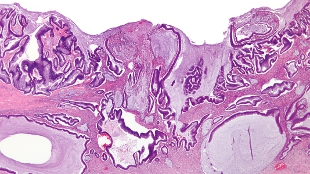
A micrograph of a mucinous adenocarcinoma of the colon, a type of colon cancer.WIKIMEDIA, NEPHRONAlleged inconsistencies and data falsification have led to the retraction of two papers on colon cancer biomarkers, according to Retraction Watch. These papers are the third and fourth yanked from the literature for the research group, formerly at Johns Hopkins School of Medicine.

One of the papers, on new biomarkers for colorectal cancer, was pulled from the March 1, 2008, issue of Clinical Cancer Research, after being cited 21 times, according to ISI. “The authors feel that the inconsistencies in the data collection and recordation warrant retraction of the article,” the coauthors of the paper wrote in the retraction notice. “Five of the 6 authors of the original article agreed to this Retraction,” they noted. “Attempts on the part of the journal office to contact the first author, Eddy S. Leman, were unsuccessful.”

Leman was also lead author on the second paper, published in the June 15, 2007, issue of Cancer Research and cited 31 times, according to ISI. That paper, on other novel colorectal cancer biomarkers, was ...

Interested in reading more?

Become a Member of

The Scientist Logo
Receive full access to more than 35 years of archives, as well as TS Digest, digital editions of The Scientist, feature stories, and much more!
Already a member?
Add The Scientist as a preferred source on Google

Add The Scientist as a preferred Google source to see more of our trusted coverage.

Meet the Author

  • From 2017 to 2022, Bob Grant was Editor in Chief of The Scientist, where he started in 2007 as a Staff Writer. Before joining the team, he worked as a reporter at Audubon and earned a master’s degree in science journalism from New York University. In his previous life, he pursued a career in science, getting a bachelor’s degree in wildlife biology from Montana State University and a master’s degree in marine biology from the College of Charleston in South Carolina. Bob edited Reading Frames and other sections of the magazine.

    View Full Profile

Related Topics

Related articles background image
The Scientist Digest cover September 2026
September 2026

Multiplex Microscopy Becomes Easier with Encoded Antibodies

A new system that enables researchers to uniquely tag monoclonal antibodies for use in microscopy could help simplify complex imaging studies.

View this Issue
Essential Genes Are Dominantly Activated by Single Transcription Factors

Essential Genes Are Dominantly Activated by Single Transcription Factors

EpiCypher Logo
Rethinking ALS Biomarkers: From Discovery to Clinical Impact

Rethinking ALS Biomarkers: From Discovery to Clinical Impact

Alamar Biosciences logo
Engineering CAR-Neutrophils In Vivo to Target Glioblastoma

Engineering CAR-Neutrophils In Vivo to Target Glioblastoma

Miltenyi
Best Practices for qPCR Assay Design and Optimization

Best Practices for qPCR Assay Design and Optimization

Bio-Rad

Products

Closeup image of a multi channel pipette dispensing pink liquid into a 96-well plate.

The ASSIST PLUS pipetting robot for affordable workflow automation

Integra Logo
Single cells in suspension

Rapidly isolate primary cells and make uniform single-cell suspensions with Corning® Cell Strainers

Corning logo
Abstract image representing cell membranes linked together.

CellBrite® Steady Membrane Stain: Cell surface staining built for real-time imaging

Biotium
sino biological logo

Monod Bio Licenses AI-designed Protein Technologies to SignalChem Biotech for Custom Discovery Assays