Clean Wood = Fewer Insects

A study finds that fumigating or heat treating wooden pallets and crates can slow the spread of bark- and wood-boring insect pests such as the emerald ash borer.

Written byBob Grant
| 2 min read

Register for free to listen to this article
Listen with Speechify
0:00
2:00
Share

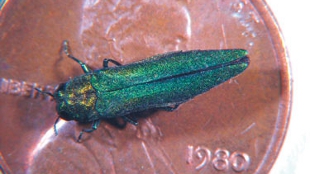
The emerald ash borer (Agrilus plantipenis) kills ash trees by chewing through xylem and phloem tissues as larvae.WIKIMEDIA, USDATreating wooden packing materials, such as pallets and crates, with heat or pesticides can slow the spread of insect pests such as the emerald ask borer and is economical, according to new analyses of international standards that govern such preventive treatments.

Infestation rates of bark- and wood-boring insects in wooden packing materials decreased by up to 52 percent from 2003 to 2009 after the implementation of International Standards for Phytosanitary Measures No. 15 (ISPM15) in 2005-2006, according to study that came out earlier this month (May 14) in PLOS ONE. ISPM15 mandates that all wooden packing materials that are more than 6 millimeters thick and being shipped between 70 signatory countries (including the U.S.) be debarked and then heated or fumigated with methyl bromide.

Writing in Frontiers in Ecology and the Environment, an international team led by investigators at McGill University in Montreal, Canada, calculated the economic benefit of the expensive preventive measure, claiming that even though ISPM15 costs about $1.50 per pallet, the practice could ...

Interested in reading more?

Become a Member of

The Scientist Logo
Receive full access to more than 35 years of archives, as well as TS Digest, digital editions of The Scientist, feature stories, and much more!
Already a member? Login Here

Related Topics

Meet the Author

  • From 2017 to 2022, Bob Grant was Editor in Chief of The Scientist, where he started in 2007 as a Staff Writer. Before joining the team, he worked as a reporter at Audubon and earned a master’s degree in science journalism from New York University. In his previous life, he pursued a career in science, getting a bachelor’s degree in wildlife biology from Montana State University and a master’s degree in marine biology from the College of Charleston in South Carolina. Bob edited Reading Frames and other sections of the magazine.

    View Full Profile
Share
Image of a woman with her hands across her stomach. She has a look of discomfort on her face. There is a blown up image of her stomach next to her and it has colorful butterflies and gut bacteria all swarming within the gut.
November 2025, Issue 1

Why Do We Feel Butterflies in the Stomach?

These fluttering sensations are the brain’s reaction to certain emotions, which can be amplified or soothed by the gut’s own “bugs".

View this Issue
Olga Anczukow and Ryan Englander discuss how transcriptome splicing affects immune system function in lung cancer.

Long-Read RNA Sequencing Reveals a Regulatory Role for Splicing in Immunotherapy Responses

Pacific Biosciences logo
Research Roundtable: The Evolving World of Spatial Biology

Research Roundtable: The Evolving World of Spatial Biology

Conceptual cartoon image of gene editing technology

Exploring the State of the Art in Gene Editing Techniques

Bio-Rad
Conceptual image of a doctor holding a brain puzzle, representing Alzheimer's disease diagnosis.

Simplifying Early Alzheimer’s Disease Diagnosis with Blood Testing

fujirebio logo

Products

Eppendorf Logo

Research on rewiring neural circuit in fruit flies wins 2025 Eppendorf & Science Prize

Evident Logo

EVIDENT's New FLUOVIEW FV5000 Redefines the Boundaries of Confocal and Multiphoton Imaging

Evident Logo

EVIDENT Launches Sixth Annual Image of the Year Contest

10x Genomics Logo

10x Genomics Launches the Next Generation of Chromium Flex to Empower Scientists to Massively Scale Single Cell Research







