CRISPR Improves Disease in Adult Mice

Three groups of researchers used the gene-editing method to restore a protein deficient in Duchenne muscular dystrophy.

Written byKerry Grens
| 2 min read

Register for free to listen to this article
Listen with Speechify
0:00
2:00
Share

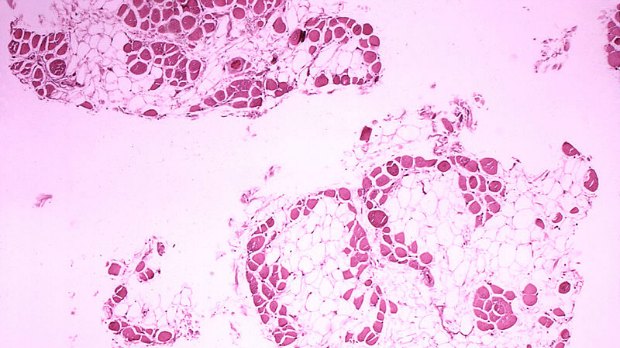
WIKIMEDIA, CENTERS FOR DISEASE CONTROL AND PREVENTION'S PUBLIC HEALTH IMAGE LIBRARYCRISPR has fixed the protein problems in adult mice that lie at the root of Duchenne muscular dystrophy (DMD), a progressive disease that saps kids of muscle strength and ultimately shortens their lives. Scientists had succeeded in using the gene-editing technique to restore protein function in human cells or mouse embryos, but this is the first time adult animals have been treated.

“The hope for gene editing is that if we do this right, we will only need to do one treatment,” Duke University’s Charlie Gersbach, who led one of three independent research teams that published results in Science last week (December 31), told The New York Times. “This method, if proven safe, could be applied to patients in the foreseeable future.”

The problematic protein is called dystrophin. All three groups took the same approach, first demonstrated in mouse embryos by Eric Olson of the University of Texas Southwestern Medical Center in 2014, to correct dystrophin deficiencies. They clipped a mutant exon from the gene for dystrophin, resulting in a truncated but functional protein. “Importantly, in principle, the same strategy can be applied to numerous types of ...

Interested in reading more?

Become a Member of

The Scientist Logo
Receive full access to more than 35 years of archives, as well as TS Digest, digital editions of The Scientist, feature stories, and much more!
Already a member? Login Here

Related Topics

Meet the Author

  • kerry grens

    Kerry served as The Scientist’s news director until 2021. Before joining The Scientist in 2013, she was a stringer for Reuters Health, the senior health and science reporter at WHYY in Philadelphia, and the health and science reporter at New Hampshire Public Radio. Kerry got her start in journalism as a AAAS Mass Media fellow at KUNC in Colorado. She has a master’s in biological sciences from Stanford University and a biology degree from Loyola University Chicago.

    View Full Profile
Share
Image of a woman with her hands across her stomach. She has a look of discomfort on her face. There is a blown up image of her stomach next to her and it has colorful butterflies and gut bacteria all swarming within the gut.
November 2025, Issue 1

Why Do We Feel Butterflies in the Stomach?

These fluttering sensations are the brain’s reaction to certain emotions, which can be amplified or soothed by the gut’s own “bugs".

View this Issue
Olga Anczukow and Ryan Englander discuss how transcriptome splicing affects immune system function in lung cancer.

Long-Read RNA Sequencing Reveals a Regulatory Role for Splicing in Immunotherapy Responses

Pacific Biosciences logo
Research Roundtable: The Evolving World of Spatial Biology

Research Roundtable: The Evolving World of Spatial Biology

Conceptual cartoon image of gene editing technology

Exploring the State of the Art in Gene Editing Techniques

Bio-Rad
Conceptual image of a doctor holding a brain puzzle, representing Alzheimer's disease diagnosis.

Simplifying Early Alzheimer’s Disease Diagnosis with Blood Testing

fujirebio logo

Products

Labvantage Logo

LabVantage Solutions Awarded $22.3 Million U.S Customs and Border Protection Contract to Deliver Next-Generation Forensic LIMS

The Scientist Placeholder Image

Evosep Unveils Open Innovation Initiative to Expand Standardization in Proteomics

OGT logo

OGT expands MRD detection capabilities with new SureSeq Myeloid MRD Plus NGS Panel