Looking for Loners

A new algorithm opens doors for detecting rare cell types in mRNA sequencing.

Written byKaren Zusi
| 2 min read

Register for free to listen to this article
Listen with Speechify
0:00
2:00
Share

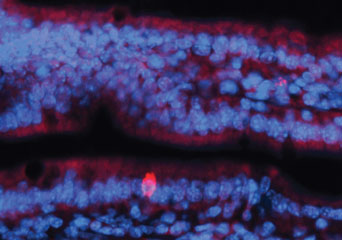
ODDBALLS: Intestinal epithelium from a mouse with a single rare enteroendocrine cell positive for the Reg4 marker (bright pink)ANNA LYUBIMOVA

The paper D. Grün et al., “Single-cell messenger RNA sequencing reveals rare intestinal cell types,” Nature, 525:251-55, 2015. Individuality The advent of mRNA sequencing for individual cells has given scientists unprecedented insight into the diversity of cell populations once thought to be uniform. But finding an analysis sensitive enough to pick up rare cell types within a tissue is a challenge, says Dominic Grün, a quantitative biologist now at the Max Planck Institute of Immunobiology and Epigenetics in Germany. An intestinal model To develop a technique that could pinpoint uncommon cells, Grün started with sequencing the cells in intestinal organoids and creating clusters of similar transcriptome profiles. Knowing how much gene-expression variability he could expect in a group of homogeneous cells, Grün picked out clusters ...

Interested in reading more?

Become a Member of

The Scientist Logo
Receive full access to digital editions of The Scientist, as well as TS Digest, feature stories, more than 35 years of archives, and much more!
Already a member? Login Here

Related Topics

Meet the Author

Published In

Share
Illustration of a developing fetus surrounded by a clear fluid with a subtle yellow tinge, representing amniotic fluid.
January 2026, Issue 1

What Is the Amniotic Fluid Composed of?

The liquid world of fetal development provides a rich source of nutrition and protection tailored to meet the needs of the growing fetus.

View this Issue
Redefining Immunology Through Advanced Technologies

Redefining Immunology Through Advanced Technologies

Skip the Wait for Protein Stability Data with Aunty

Skip the Wait for Protein Stability Data with Aunty

Unchained Labs
Graphic of three DNA helices in various colors

An Automated DNA-to-Data Framework for Production-Scale Sequencing

illumina
Exploring Cellular Organization with Spatial Proteomics

Exploring Cellular Organization with Spatial Proteomics

Products

nuclera logo

Nuclera eProtein Discovery System installed at leading Universities in Taiwan

Brandtech Logo

BRANDTECH Scientific Introduces the Transferpette® pro Micropipette: A New Twist on Comfort and Control

Biotium Logo

Biotium Launches GlycoLiner™ Cell Surface Glycoprotein Labeling Kits for Rapid and Selective Cell Surface Imaging

Colorful abstract spiral dot pattern on a black background

Thermo Scientific X and S Series General Purpose Centrifuges

Thermo Fisher Logo