


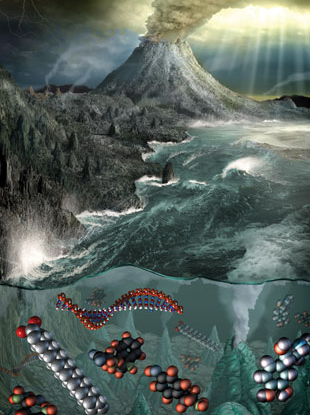
 © KEVIN HANDOrigin-of-life researchers have traditionally been categorized into a “genetics first” camp, which ascribes to the notion that some sort of information molecule was a necessary prerequisite for life, and a “metabolism first” group, in which studies focus on understanding the chemical cycles that led to the synthesis of organic molecules. But in a paper published this week (March 16) in Nature, scientists presented evidence that both genetics and metabolism may have arisen simultaneously, via a reaction involving ?hydrogen cyanide and hydrogen sulfide, driven by ultraviolet (UV) light.
“This is a very important paper,” Jack Szostak, a molecular biologist and origin-of-life researcher at Massachusetts General Hospital in Boston, told Science. “It proposes for the first time a scenario by which almost all of the essential building blocks for life could be assembled in one geological setting.”
In 2009, John Sutherland of the Medical Research Council Laboratory of Molecular Biology in the U.K. and his colleagues demonstrated that the basic sugars glycolaldehyde and glyceraldehyde could be used to create RNA’s pyrimidine nucleotides, cytidine (C) and uridine (U), under conditions consistent with early-Earth geochemical models. Then, in September 2012, Sutherland’s team found that these sugars could be derived from the even simpler hydrogen cyanide, which itself is suspected to have been present on prebiotic Earth.
...














