Watt Fun!

Her doctoral advisor told her to amuse herself, and Fiona Watt has done just that—probing individual stem cells and determining the genes and molecules that direct them to differentiate or cause them to contribute to cancer.

Written byKaren Hopkin
| 9 min read

Register for free to listen to this article
Listen with Speechify
0:00
9:00
Share

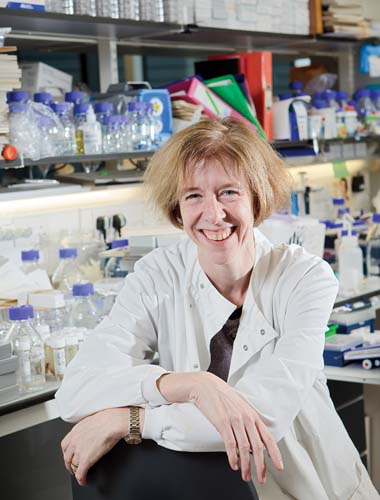
Fiona Watt: Deputy Director, Wellcome Trust Centre for Stem Cell Research; Herchel Smith Professor of Molecular Genetics, University of Cambridge; Deputy Director, Cancer Research UK, Cambridge Research Institute. ALEX RUMFORD

Fiona Watt finished her thesis research in record time. It was the late 1970s, and Watt had joined the lab of Henry Harris at Oxford University. Harris had perfected a method for fusing normal cells with cancer cells, an approach that allowed him to look for molecules that prevented the abnormal growth of the resulting hybrid. “When I first went to see Professor Harris, he told me, ‘There are only two intellectually important problems: cancer and differentiation,’” says Watt. “Of course, I agreed—and still do! Then he asked, ‘Which do you want to work on?’ I said, ‘Differentiation.’ So he gave me cancer.”

At the time, Harris had compiled a list of potential molecular markers for cancer cells. His students were working their way down ...

Interested in reading more?

Become a Member of

The Scientist Logo
Receive full access to more than 35 years of archives, as well as TS Digest, digital editions of The Scientist, feature stories, and much more!
Already a member? Login Here

Related Topics

Meet the Author

Share
Illustration of a developing fetus surrounded by a clear fluid with a subtle yellow tinge, representing amniotic fluid.
January 2026, Issue 1

What Is the Amniotic Fluid Composed of?

The liquid world of fetal development provides a rich source of nutrition and protection tailored to meet the needs of the growing fetus.

View this Issue
Skip the Wait for Protein Stability Data with Aunty

Skip the Wait for Protein Stability Data with Aunty

Unchained Labs
Graphic of three DNA helices in various colors

An Automated DNA-to-Data Framework for Production-Scale Sequencing

illumina
Exploring Cellular Organization with Spatial Proteomics

Exploring Cellular Organization with Spatial Proteomics

Abstract illustration of spheres with multiple layers, representing endoderm, ectoderm, and mesoderm derived organoids

Organoid Origins and How to Grow Them

Thermo Fisher Logo

Products

Brandtech Logo

BRANDTECH Scientific Introduces the Transferpette® pro Micropipette: A New Twist on Comfort and Control

Biotium Logo

Biotium Launches GlycoLiner™ Cell Surface Glycoprotein Labeling Kits for Rapid and Selective Cell Surface Imaging

Colorful abstract spiral dot pattern on a black background

Thermo Scientific X and S Series General Purpose Centrifuges

Thermo Fisher Logo
Abstract background with red and blue laser lights

VANTAstar Flexible microplate reader with simplified workflows

BMG LABTECH