Report: WHO Unfit for Public Health Emergency

An international panel concludes that the World Health Organization is not prepared to handle another emergency like the Ebola outbreak in West Africa.

Written byJef Akst
| 2 min read

Register for free to listen to this article
Listen with Speechify
0:00
2:00

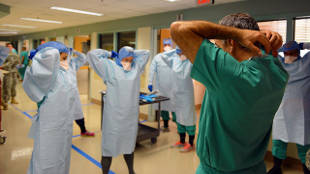
FLICKR, ARMY MEDICINEThe ongoing Ebola outbreak has put the World Health Organization (WHO) in the spotlight, and according to a report issued this week (July 7) by an independent panel of public-health experts, the agency “does not currently possess the capacity or organizational culture to deliver a full emergency public health response.”

Specifically, the panel found that the WHO is underfunded, slow to respond, and too dependent on “good diplomacy.” The report said that the agency took too long to declare a public health emergency in West Africa—in August 2014, after more than 1,000 Ebola-related deaths—and specifically called out Director General Margaret Chan for lacking “independent and courageous decision making.” Chan previously acknowledged that she should have declared the Ebola situation a public health emergency sooner than she did.

The panel suggested that the WHO likely shied away from challenging local governments for fear of the economic and trade consequences, and noted that regional and national WHO representatives may do well to lead the charge in future emergency situations. It also called for donor countries to immediately ...

Interested in reading more?

Become a Member of

The Scientist Logo
Receive full access to more than 35 years of archives, as well as TS Digest, digital editions of The Scientist, feature stories, and much more!
Already a member?
Add The Scientist as a preferred source on Google

Add The Scientist as a preferred Google source to see more of our trusted coverage.

Meet the Author

  • Jef (an unusual nickname for Jennifer) got her master’s degree from Indiana University in April 2009 studying the mating behavior of seahorses. After four years of diving off the Gulf Coast of Tampa and performing behavioral experiments at the Tennessee Aquarium in Chattanooga, she left research to pursue a career in science writing. As The Scientist's managing editor, Jef edited features and oversaw the production of the TS Digest and quarterly print magazine. In 2022, her feature on uterus transplantation earned first place in the trade category of the Awards for Excellence in Health Care Journalism. She is a member of the National Association of Science Writers.

    View Full Profile

Related Topics

Related articles background image
August 2026 Digest cover
August 2026

Epic Fail: Sea-Monkeys Sabotage Fieldwork

When Barry Hicks set out to photograph thrombolites, thousands of unexpected visitors photobombed his underwater images.

View this Issue
Overcoming Immunotherapy Resistance in Liver Cancer

Overcoming Immunotherapy Resistance in Liver Cancer

Axion Biosystems
Optimizing NGS Library Preparation for Reliable Sequencing Data

Optimizing NGS Library Preparation for Reliable Sequencing Data

Covaris
Using TCR Repertoire Sequencing to Advance Immunology Research

Using TCR Repertoire Sequencing to Advance Immunology Research

Miltenyi
Mapping Clonal Mosaicism in Aging Tissues

Mapping Clonal Mosaicism in Aging Tissues

Mission bio

Products

Sino Biological Logo

Sino Biological Launches SuperNuclease ® Pro with Free Trial Program

Sino Biological Logo

Sino Biological Launches Precisely Characterized Full-Length p-Tau217 Protein to Advance Next-Generation Alzheimer’s Biomarker Assay Development

A photo of a scientist placing the Resipher device on a 96-well plate.

Resipher: Continuous Live-Cell Mitochondrial Respiration Monitoring in 96-Well Plates

Lucid Scientific logo
Conceptual image of ice and frost.

The VAULT100 PRO: Inside the most advanced Stirling Ultracold ULT freezer ever built.

Stirling Ultracold logo










