

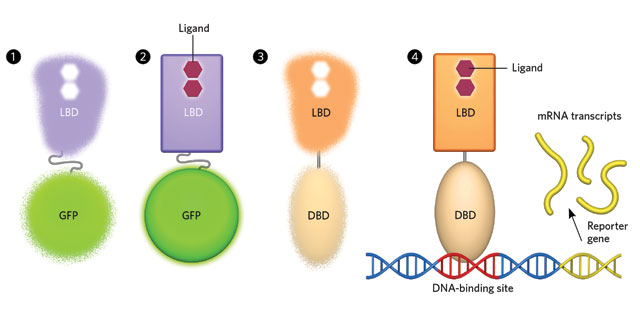
 SENSOR SET-UP: To detect a small molecule of interest (the ligand), a conditionally stable ligand-binding domain (LBD) is fused to a reporter, such as green fluorescent protein (GFP). The complex degrades if the ligand is not present (1), and activates the reporter when it is (2). In another demonstration of this sensor, researchers connected the LBD to a DNA-binding domain (DBD) (3). When the ligand is present, the DBD hooks onto to a site in the genome (red), which results in the expression of a specified reporter gene (yellow) (4).© GEORGE RETSECK; ELIFE, 4:E10606, 2015See the full article here.
Sense and Sensibility
Tailored combinations of a reporter and a ligand-binding domain allow for sensing just about any molecule of interest.
Written byRuth Williams
| 1 min read
Register for free to listen to this article
Listen with Speechify
0:00
1:00
Share
Interested in reading more?

The Scientist ARCHIVES
Become a Member of

Receive full access to more than 35 years of archives, as well as TS Digest, digital editions of The Scientist, feature stories, and much more!
Already a member? Login Here
Related Topics
Meet the Author

Ruth is a freelance journalist. Before freelancing, Ruth was a news editor for the Journal of Cell Biology in New York and an assistant editor for Nature Reviews Neuroscience in London. Prior to that, she was a bona fide pipette-wielding, test tube–shaking, lab coat–shirking research scientist. She has a PhD in genetics from King’s College London, and was a postdoc in stem cell biology at Imperial College London. Today she lives and writes in Connecticut.
View Full Profile
Share












