Adding Padding

Adipogenesis in mice has alternating genetic requirements throughout the animals’ lives.

Written byKaren Zusi
| 2 min read

Register for free to listen to this article
Listen with Speechify
0:00
2:00
Share

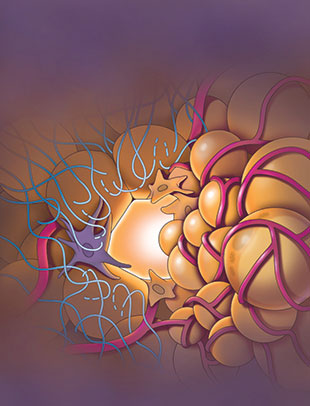
FAT, ETC.: Artistic representation of fat cells (gold, round), surrounded by blood vessels (pink), fibroblasts (gold, star-shape), and a macrophage (purple) COURTESY OF PHILIPP SCHERER AND INGRID WERNSTEDT ASTERHOLM/GRAPHIC BY VISUALLY MEDICAL

The paper Q.A. Wang et al., “Distinct regulatory mechanisms governing embryonic versus adult adipocyte maturation,” Nature Cell Biol, 17:1099-111, 2015. Pumping up Fat-cell development from precursors is an essential process that occurs throughout life, but when in overdrive, contributes to obesity and metabolic dysfunction. In charge of fat-cell production are two transcription factors, PPARγ and C/EBPα, present in the cell nuclei of adipocytes. To observe their dynamics at different life stages, Philipp Scherer at the University of Texas Southwestern Medical Center and colleagues needed to look in vivo. Diverging pathways The researchers created transgenic mice that selectively lost expression of C/EBPα or of PPARγ, predominantly in developing and mature adipocytes. When C/EBPα was knocked out in embryos, the animals’ subcutaneous fat still developed normally, while ...

Interested in reading more?

Become a Member of

The Scientist Logo
Receive full access to digital editions of The Scientist, as well as TS Digest, feature stories, more than 35 years of archives, and much more!
Already a member? Login Here
Illustration of a developing fetus surrounded by a clear fluid with a subtle yellow tinge, representing amniotic fluid.
January 2026, Issue 1

What Is the Amniotic Fluid Composed of?

The liquid world of fetal development provides a rich source of nutrition and protection tailored to meet the needs of the growing fetus.

View this Issue
Skip the Wait for Protein Stability Data with Aunty

Skip the Wait for Protein Stability Data with Aunty

Unchained Labs
Graphic of three DNA helices in various colors

An Automated DNA-to-Data Framework for Production-Scale Sequencing

illumina
Exploring Cellular Organization with Spatial Proteomics

Exploring Cellular Organization with Spatial Proteomics

Abstract illustration of spheres with multiple layers, representing endoderm, ectoderm, and mesoderm derived organoids

Organoid Origins and How to Grow Them

Thermo Fisher Logo

Products

Brandtech Logo

BRANDTECH Scientific Introduces the Transferpette® pro Micropipette: A New Twist on Comfort and Control

Biotium Logo

Biotium Launches GlycoLiner™ Cell Surface Glycoprotein Labeling Kits for Rapid and Selective Cell Surface Imaging

Colorful abstract spiral dot pattern on a black background

Thermo Scientific X and S Series General Purpose Centrifuges

Thermo Fisher Logo
Abstract background with red and blue laser lights

VANTAstar Flexible microplate reader with simplified workflows

BMG LABTECH










