Arrested Development Makes for Long-Lived Worms

Starvation suspends cellular activity in C. elegans larvae and extends their lifespan.

Written byJyoti Madhusoodanan
| 1 min read

Register for free to listen to this article
Listen with Speechify
0:00
1:00
Share

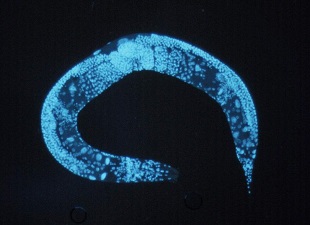
WIKIMEDIACutting back on food makes worms live twice as long as normal, according to a study published last week (June 19) in PLOS Genetics.

Caenorhabditis elegans grow from larvae to adulthood in three to four days, making the nematodes an ideal model for studying development. Researchers at Duke University found that when C. elegans larvae were starved at a stage when they’re actively forming large amounts of tissue, the worms quickly entered a quiescent state.

The arrest in cellular activity occurred at previously unknown checkpoints. The researchers’ results suggested that insulin-like and steroid hormone signaling mechanisms regulated this process.

“These pathways are conserved in mammals and are linked to growth processes and diseases,” the authors wrote in their paper. “It is possible that similar checkpoints may also be important in human development.”

Being starved for as long as two weeks at this late larval stage had no apparent effects ...

Interested in reading more?

Become a Member of

The Scientist Logo
Receive full access to more than 35 years of archives, as well as TS Digest, digital editions of The Scientist, feature stories, and much more!
Already a member? Login Here
Image of a woman with her hands across her stomach. She has a look of discomfort on her face. There is a blown up image of her stomach next to her and it has colorful butterflies and gut bacteria all swarming within the gut.
November 2025, Issue 1

Why Do We Feel Butterflies in the Stomach?

These fluttering sensations are the brain’s reaction to certain emotions, which can be amplified or soothed by the gut’s own “bugs".

View this Issue
Olga Anczukow and Ryan Englander discuss how transcriptome splicing affects immune system function in lung cancer.

Long-Read RNA Sequencing Reveals a Regulatory Role for Splicing in Immunotherapy Responses

Pacific Biosciences logo
Research Roundtable: The Evolving World of Spatial Biology

Research Roundtable: The Evolving World of Spatial Biology

Conceptual cartoon image of gene editing technology

Exploring the State of the Art in Gene Editing Techniques

Bio-Rad
Conceptual image of a doctor holding a brain puzzle, representing Alzheimer's disease diagnosis.

Simplifying Early Alzheimer’s Disease Diagnosis with Blood Testing

fujirebio logo

Products

Labvantage Logo

LabVantage Solutions Awarded $22.3 Million U.S Customs and Border Protection Contract to Deliver Next-Generation Forensic LIMS

The Scientist Placeholder Image

Evosep Unveils Open Innovation Initiative to Expand Standardization in Proteomics

OGT logo

OGT expands MRD detection capabilities with new SureSeq Myeloid MRD Plus NGS Panel










