

Stay up to date on the latest science with Brush Up Summaries.

What Is Real World Data (RWD)?
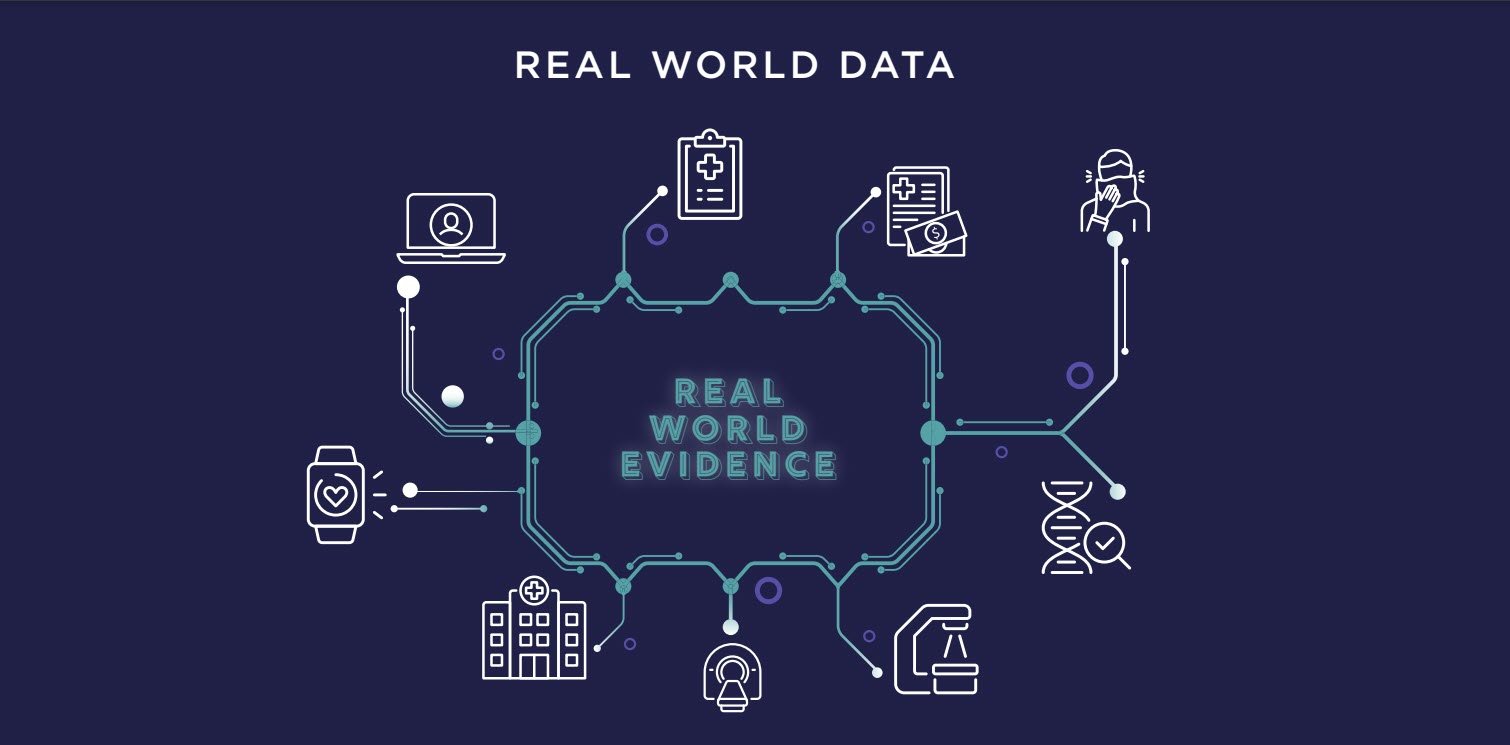
RWD is paving the way towards generating insights that can drive decisions in the life sciences and healthcare industries. RWD are data related to the health status of patients and/or the provision of health care; this data is regularly obtained from a range sources.1 Some major sources of RWD and examples of data collected from these are as follows.
Source | Examples of RWD |
Electronic health records (EHRs) | Patient demographics, medical history, diagnoses, laboratory results, medical procedures |
Administrative claims and billing databases | Hospitalizations, emergency department visits, outpatient visits, medication orders, laboratory tests |
Patient and disease registries | Clinical measures, treatments and outcomes for patients with specific conditions |
Social media platforms | Patient communities, blogs, Twitter and Facebook posts about patient experiences |
Patient reported outcomes (PROs) | Information on symptoms experienced by patients, satisfaction with care, adherence to treatments |
Wearable devices | Measures of physical activity and bodily functions such as heart rate, sleep, and respiratory rate |
RWD can provide information about healthcare outcomes among diverse patient populations, and these valuable data sources complement and expand on information collected from traditional clinical trials.
What Are the Differences Between RWD and Clinical Data?
Clinical data is usually collected under controlled conditions. In studies such as randomized clinical trials, patients who meet strict inclusion and exclusion criteria are enrolled and monitored throughout the trial period. During this time, researchers collect patient data for a limited number of variables. In contrast, real world data tends to be observational in nature, as it is commonly collected in clinical practice and real-world environments. RWD can be more comprehensive in nature compared to clinical data, and it can be collected in more diverse populations that better represent the complexity of actual healthcare.2
How Are RWD and Real World Evidence (RWE) Related?
RWD and real world evidence (RWE) are closely related, but they are not interchangeable. Real world data can be processed and analyzed through advanced analytical methods, such as data mining, machine learning, and artificial intelligence. This allows researchers to uncover patterns in RWD and make discoveries in health research. RWE refers to the meaningful insights and conclusions extracted from real world data. Healthcare stakeholders can use RWE generated from RWD to make decisions and facilitate healthcare planning.3
How Can We Leverage RWD?
The use of RWD provides several opportunities for research and healthcare delivery. Real world data can help validate findings from clinical trials and evaluate the effectiveness and safety of treatments, products, and patient programs in real-world settings. Experts in the life sciences industry, including pharmaceutical and biotech companies, can use this information to support regulatory approvals and post-approval validations of healthcare products and interventions.4
RWD can also support research and development, including the design of clinical trials and the identification of unmet healthcare needs and of patient subgroups that may benefit more from specific treatments or interventions. All of this can help drive improvements in patient care, including earlier and more accurate diagnoses and better treatments.
What Are the Challenges Associated with Using RWD?
A major challenge in RWD usage relates to problems with data quality, as RWD that is routinely collected outside of controlled study settings may be inconsistent, inaccurate, or incomplete. The lack of standardization in data collection and coding across different healthcare systems and regions also poses a challenge for RWD integration and analysis. Ethical and privacy concerns related to patient data collection and sharing are additional aspects for consideration. Continued efforts in improving patient data completeness, standardization, and representativeness are required to account for errors and biases that may be present in RWD.
RWD In Action: RWE Studies
Among a wide range of applications, researchers and clinicians have leveraged RWD to evaluate the real-world effectiveness of cancer therapies,5 digital health interventions for mental health,6 and COVID-19 vaccinations.7
These examples illustrate the value of RWD. Indeed, real world data is expected to play an increasingly important role in healthcare research and decision-making in the years to come.
About the Author: Liliana Garcia Mondragon received her PhD in medical research from the Ludwig Maximilian University of Munich, where she analyzed health-related data from large participant samples to identify environmental and biological risk factors for psychopathology. She has carried out research for companies in the digital health and medtech sectors to enhance the real-world use of mobile applications for mental health management and medical devices for lung cancer detection.

- US Food and Drug Administration, "Real-World Evidence," 2022. Available from: https://www.fda.gov/science-research/science-and-research-special-topics/real-world-evidence
2. D. Chodankar, "Introduction to real-world evidence studies," Perspect Clin Res, 12(3):171-74, 2021. doi: 10.4103/picr.picr_62_21
3. F. Liu, P. Demosthenes, "Real-world data: a brief review of the methods, applications, challenges and opportunities," BMC Med Res Methodol, 22(1):287, 2022. doi: 10.1186/s12874-022-01768-6
4. G. Jones, "Real-world data (RWD) vs. real-world evidence (RWE)," 2022. Available from: https://blogs.oracle.com/health-sciences/post/real-world-data-vs-real-world-evidence
5. C.M. Phillips et al., "Assessing the efficacy-effectiveness gap for cancer therapies: A comparison of overall survival and toxicity between clinical trial and population-based, real-world data for contemporary parenteral cancer therapeutics," Cancer, 126(8):1717-26, 2020. doi: 10.1002/cncr.32697
6. B. Inkster et al., "An empathy-driven, conversational artificial intelligence agent (Wysa) for digital mental well-being: real-world data evaluation mixed-methods study," JMIR mHealth and uHealth, 6(11):e12106, 2018. doi: 10.2196/12106
7. D.A. Henry et al., "Effectiveness of COVID-19 vaccines: findings from real world studies," Med J Aust, 215(4):149-151.e1, 2021. doi: 10.5694/mja2.51182













