Snakes Have Clitorises After All, Study Finds

Researchers visualize the snake clitoris in detail for the first time, finding evidence that the organ may be evolutionarily important for snake sex.

Written byNatalia Mesa, PhD
| 4 min read
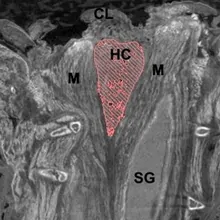
A tomography image in greyscale of snake tissues
Register for free to listen to this article
Listen with Speechify
0:00
4:00
Share

Researchers give penises a lot of attention, historically speaking. This is especially true in snakes, as scientists know a good deal about the animals’ male reproductive organs, but relatively little about the females’ organs, especially the clitoris. This led some scientists to conclude that the structure has little to do with mating in snake species, and some doubted that it exists at all.

Now, a study published today (December 13) in Proceedings of the Royal Society B sets the record straight: the snake clitoris not only exists, it may also play important roles in reproduction. Researchers at the University of Adelaide have, for the first time, described the striking diversity of snake hemiclitores in nine snake species. In doing so, they’ve provided evidence that the structure is widespread among snakes and likely has a vital function. This study adds to the growing pile of evidence that the clitoris is likely ...
Interested in reading more?

Become a Member of

The Scientist Logo
Receive full access to more than 35 years of archives, as well as TS Digest, digital editions of The Scientist, feature stories, and much more!
Already a member? Login Here

Related Topics

Meet the Author

  • A black and white headshot

    As she was completing her graduate thesis on the neuroscience of vision, Natalia found that she loved to talk to other people about how science impacts them. This passion led Natalia to take up writing and science communication, and she has contributed to outlets including Scientific American and the Broad Institute. Natalia completed her PhD in neuroscience at the University of Washington and graduated from Cornell University with a bachelor’s degree in biological sciences. She was previously an intern at The Scientist, and currently freelances from her home in Seattle. 

    View Full Profile
Share
Illustration of a developing fetus surrounded by a clear fluid with a subtle yellow tinge, representing amniotic fluid.
January 2026, Issue 1

What Is the Amniotic Fluid Composed of?

The liquid world of fetal development provides a rich source of nutrition and protection tailored to meet the needs of the growing fetus.

View this Issue
Skip the Wait for Protein Stability Data with Aunty

Skip the Wait for Protein Stability Data with Aunty

Unchained Labs
Graphic of three DNA helices in various colors

An Automated DNA-to-Data Framework for Production-Scale Sequencing

illumina
Exploring Cellular Organization with Spatial Proteomics

Exploring Cellular Organization with Spatial Proteomics

Abstract illustration of spheres with multiple layers, representing endoderm, ectoderm, and mesoderm derived organoids

Organoid Origins and How to Grow Them

Thermo Fisher Logo

Products

Brandtech Logo

BRANDTECH Scientific Introduces the Transferpette® pro Micropipette: A New Twist on Comfort and Control

Biotium Logo

Biotium Launches GlycoLiner™ Cell Surface Glycoprotein Labeling Kits for Rapid and Selective Cell Surface Imaging

Colorful abstract spiral dot pattern on a black background

Thermo Scientific X and S Series General Purpose Centrifuges

Thermo Fisher Logo
Abstract background with red and blue laser lights

VANTAstar Flexible microplate reader with simplified workflows

BMG LABTECH










