Scientists Discover First Fluorescent Frog

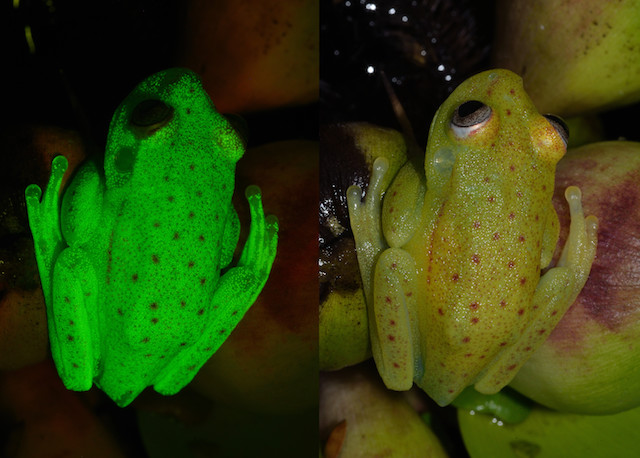
The polka dot tree frog (Hypsiboas punctatus) glows under a blacklight, due to the presence of three fluorescent molecules in its lymph tissue and skin.

Written byDiana Kwon
| 1 min read

Register for free to listen to this article
Listen with Speechify
0:00
1:00
Share

JULIÁN FAIVOVICHA AND CARLOS TABOADA

When researchers placed a polka dot tree frog (Hypsiboas punctatus) under a black light, they made an unexpected discovery. The amphibian glowed with a bright, green-blue hue, the scientists reported Monday (March 13) in PNAS.

Fluorescence exists elsewhere in the animal kingdom, in some fish, sharks, and scorpions, for example. However, this is the first amphibian scientists have discovered with this trait. “We couldn’t believe it,” study co-author Julián Faivovich, a herpetologist at the University of Buenos Aires, told Nature.

Polka dog frogs contain biliverdin, a pigment found in some insects that gives them a dim red fluorescence, coauthor Carlos Taboada, a University of Buenos Aires herpetologist, told Nature. So the team expected the frogs to glow red under a UV flashlight, but instead, they ...

Interested in reading more?

Become a Member of

The Scientist Logo
Receive full access to more than 35 years of archives, as well as TS Digest, digital editions of The Scientist, feature stories, and much more!
Already a member? Login Here

Related Topics

Meet the Author

  • Diana is a freelance science journalist who covers the life sciences, health, and academic life. She’s a regular contributor to The Scientist and her work has appeared in several other publications, including Scientific American, Knowable, and Quanta. Diana was a former intern at The Scientist and she holds a master’s degree in neuroscience from McGill University. She’s currently based in Berlin, Germany.

    View Full Profile
Share
Illustration of a developing fetus surrounded by a clear fluid with a subtle yellow tinge, representing amniotic fluid.
January 2026, Issue 1

What Is the Amniotic Fluid Composed of?

The liquid world of fetal development provides a rich source of nutrition and protection tailored to meet the needs of the growing fetus.

View this Issue
Skip the Wait for Protein Stability Data with Aunty

Skip the Wait for Protein Stability Data with Aunty

Unchained Labs
Graphic of three DNA helices in various colors

An Automated DNA-to-Data Framework for Production-Scale Sequencing

illumina
Exploring Cellular Organization with Spatial Proteomics

Exploring Cellular Organization with Spatial Proteomics

Abstract illustration of spheres with multiple layers, representing endoderm, ectoderm, and mesoderm derived organoids

Organoid Origins and How to Grow Them

Thermo Fisher Logo

Products

Brandtech Logo

BRANDTECH Scientific Introduces the Transferpette® pro Micropipette: A New Twist on Comfort and Control

Biotium Logo

Biotium Launches GlycoLiner™ Cell Surface Glycoprotein Labeling Kits for Rapid and Selective Cell Surface Imaging

Colorful abstract spiral dot pattern on a black background

Thermo Scientific X and S Series General Purpose Centrifuges

Thermo Fisher Logo
Abstract background with red and blue laser lights

VANTAstar Flexible microplate reader with simplified workflows

BMG LABTECH