



Viruses are effective tools for delivering genetic material into cells, and scientists have taken advantage of viral transduction in numerous ways, such as constructing chimeric antigen receptor (CAR) T cells for cancer therapy. However, traditional methods of T cell transduction are often error prone, time consuming, and require large amounts of material.
In May 2025, Takara Bio USA rolled out the Lenti‑X T‑Cell Transduction Sponge to address these cellular engineering pain points. The company already had a long history of supporting scientists working with viruses, being the first to commercialize retroviral vectors. “Viral delivery is actually very powerful because viruses have evolved over eons to be good at getting into cells, but they still need some sort of leg up to do that,” said Andrew Farmer, chief scientific officer and head of Research and Development at Takara Bio USA.
Their new product provides that leg up. The Lenti-X T-Cell Transduction Sponge is a lyophilized alginate cake that forms a macroporous structure. Rather than engaging in a tedious process that involves separate purification, activation, and transduction steps, scientists can use pure T cells or peripheral blood mononuclear cells mixed with the transducing virus and apply the mixture directly onto the sponge. As the Lenti-X T-Cell Transduction Sponge absorbs the mixture, the pre-loaded IL-2 cytokine and anti-CD3 and CD28 antibodies activate the T cells. The pores force the viruses and T cells into close proximity, which increases transduction efficiency. Taken together, employing the Lenti-X T-Cell Transduction Sponge cuts a complex, days-long workflow into a single step.
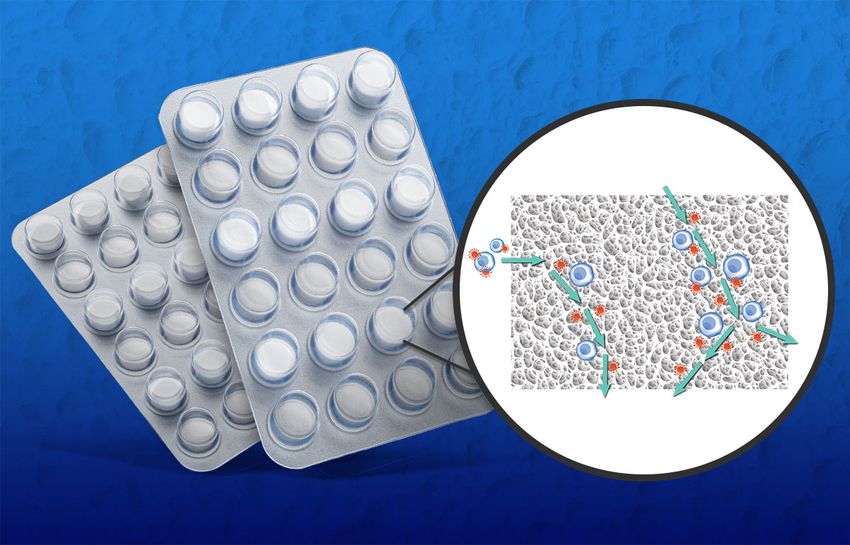
The sponge activates T cells and, with its macropores, forces viral particles and T cells together, enhancing delivery of genetic material via transduction.
Takara Bio USA
“We get activation and transduction efficiencies that are equivalent to, maybe in some cases better than, what you see with these traditional methods,” said Farmer.
The simplicity of this optimized, sponge-based process minimizes cell handling, makes screening easier, and removes barriers to entry. “It opens up access to those who aren't familiar with the T cell transduction workflow,” said Thomas Quinn, Research and Development group leader at Takara Bio USA. “It allows them to achieve their T cell modification and get to their results without having to worry about the process.”
Check out all of The Scientist's Top Innovation winners of 2025.












