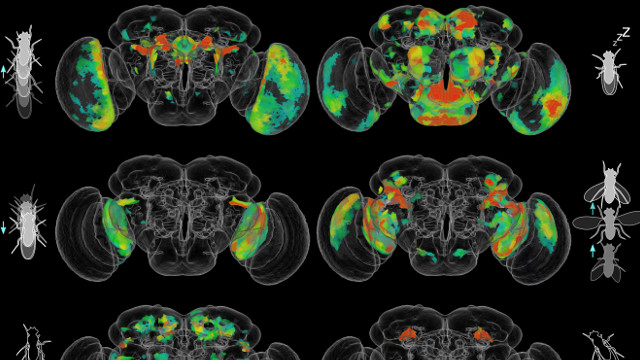
 Examples of a few of these behaviors and their corresponding behavior-anatomy maps from Robie et al. KRISTIN BRANSON, JANELIA RESEARCH CAMPUSCompared with the billions of neurons within the human brain, that of the fruit fly, Drosophila melanogaster, contains about 250,000 neurons. Yet, even identifying the neuronal circuits that produce both simple and complex behaviors such as walking, jumping and courtship is difficult in the fruit fly using currently available tools. To make the study of the neuronal basis of behavior more tractable, Kristin Branson, a neurobiologist at the Howard Hughes Medical Institute Janelia Research Campus in Virginia, and her colleagues have created a large dataset of whole-brain neural maps that show the behavioral effects of activating subsets of neurons in the adult fruit fly brain.
The results of the work, which took six years to complete, are published today (July 13) in Cell. The study authors have made the resulting catalog of brain-wide maps that link neuronal circuits with specific behaviors and the raw data freely available.
“This is an important paper and a really exciting resource for the neurobiology community that our lab definitely plans to use,” says Mala Murthy, a neuroscientist who studies acoustic communication behaviors of fruit flies at Princeton University and who was not involved in the work. “Which neurons function in what behaviors is still an open question. The general approach has been to study one neuron at a time. This full-scale approach is a very useful brain-wide tool that identifies specific brain regions linked ...