


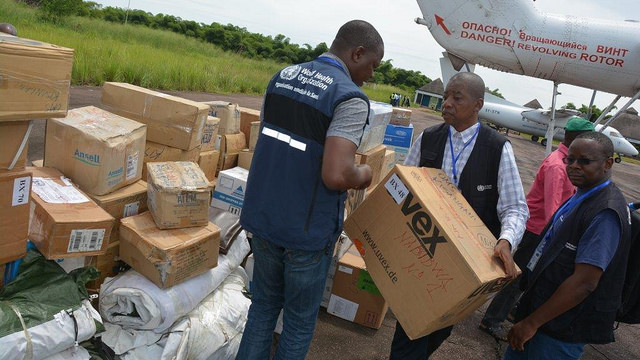
 World Health Organization workers deployed medical kits in response to reports of Ebola cases in DRC in 2017.FLICKR, MONUSCOThe US government has committed another $7 million in funds to fighting Ebola in Democratic Republic of Congo, bringing its total contribution to $8 million, according to a press statement yesterday (May 22) by US Secretary of Health and Human Services, Alex Azar. The announcement comes amid reports of another two deaths from the virus in an outbreak that has killed 27 people since April, prompting the first deployment of an experimental vaccine in the region this week.
“The risk of spreading within the country and to neighboring nations remains real,” Fatoumata Nafo-Traoré of the International Federation of Red Cross and Red Crescent Societies tells Reuters. “One of the lessons we learned in our response to other deadly Ebola outbreaks is that complacency can kill.”
Health authorities were widely criticized for failing to respond more quickly to the outbreak of Ebola in West Africa, which claimed more than 11,000 lives between 2013 and 2016. A much faster response to news of eight confirmed cases and four deaths in Democratic Republic of Congo (DRC) early last year resulted in the World Health Organization (WHO) declaring that outbreak over within a few months.
Cases began reappearing in DRC in the rural town of Bikoro earlier ...












