


In phage-assisted continuous evolution (PACE), desired protein variants are produced when a bacteriophage virus's survival depends on evolving the right variants that will interact with a target protein and turn on a gene essential for the virus's survival.
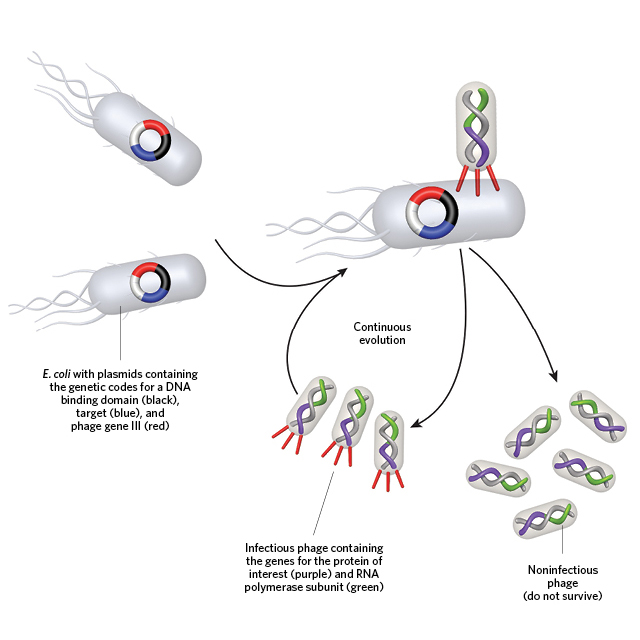 © GEORGE RETSECK To evolve a strong binding affinity between a protein of interest (POI) and a desired target, the gene for the POI (fused to an RNA polymerase subunit) is first encoded into the genome of a bacteriophage lacking a gene (gene III) critical for robust infection of bacteria. These POI-containing viruses are then cultured with E. coli that contain gene III as well as the POI’s desired target (above).
 © GEORGE RETSECKInteraction between the POI and target results in recruitment of the E. coli RNA polymerase to the gene III promoter (black), which drives transcription (above). Thus, only those viruses whose POI evolves a strong binding affinity for the target will be able to drive gene III expression, continuously infect the E. coli, and survive.
Read the full story.












