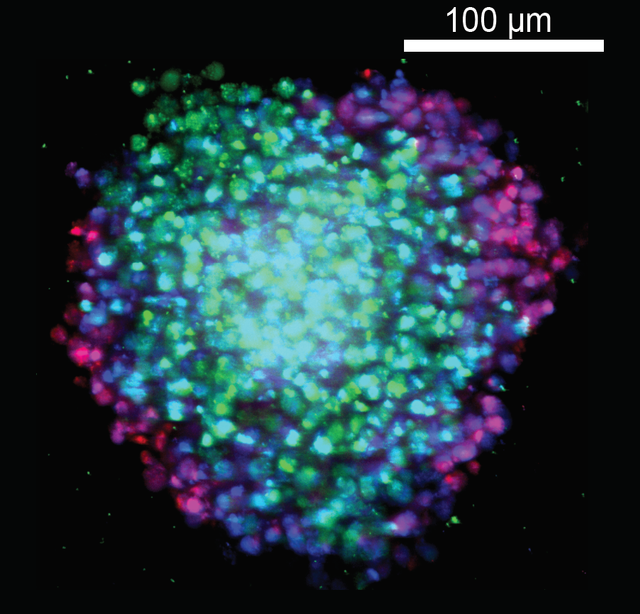
Image of the Day: Cancer Spheroid

3-D balls of cells can be used to screen for potential cancer drugs.

Brought to you byThe Scientist
| 1 min read

Register for free to listen to this article
Listen with Speechify
0:00
1:00

Researchers used a technique called confocal microscopy to confirm that the cells were forming spheres. KOTA ET AL./THE SCRIPPS RESEARCH INSTITUTE

In a study published Monday (May 14) in Oncogene, researches report that they have devised a method for screening new cancer-fighting compounds using 3-D balls of cells called “spheroids.” The technique is designed to better mimic the conditions found in the body compared to traditional 2-D cell cultures.

“From our perspective, this is a proof-of-principle study,” says coauthor Joseph Kissil, a molecular biologist at the Scripps Research Institute, in a statement. “It shows you can look at libraries of drugs that have already been approved for other diseases, and find drugs that may also work for cancer. In theory, you could use this screening method for any line of cancer cells, and any mutation you want.”

S. Kota et al., “A novel three-dimensional high-throughput screening ...

Interested in reading more?

Become a Member of

The Scientist Logo
Receive full access to more than 35 years of archives, as well as TS Digest, digital editions of The Scientist, feature stories, and much more!
Already a member?
Add The Scientist as a preferred source on Google

Add The Scientist as a preferred Google source to see more of our trusted coverage.

Related Topics

November digest cover
November 2026

Chemistry Meets Arcade Combat in “Reaction Rumble” Game

Choose your fighter! Enter the arena as chemical elements and dole out moves inspired by real-world reactions in this educational browser-based game.

View this Issue
Engineering Bispecific Antibodies Against Emerging Viruses

Engineering Bispecific Antibodies Against Emerging Viruses

innovative-research-horizontal-lock-inverted-rgb-900px-w-72ppi
Advancing Research With Humanized Mouse Models

Advancing Research with Next-Generation Humanized Mouse Models

bioxcell
3d illustration showing amyloid plaques in Alzheimer's disease

Best Practices for Blood-Based Amyloid Pathology Testing

fujirebio logo
Optimizing Critical Steps in T-Cell Engineering

Optimizing Critical Steps in T-Cell Engineering

Fujifilm

Products

Abstract image of circles and concentric lines on a blue and pink background.

MX Analytical and Precision Balances: Effortless Weighing and Secure Data Handling

Mettler
3D multicolored conceptual image of antibody molecules

Premium BsAb: LC-MS-Assisted Bispecific Antibody Production with >98% Heterodimer Purity

WuXi Biologics
Abstract conceptual image of AI technology for medical science research.

Exploring a New Era of Pharmaceutical Innovation

A photograph of plastic fragments floating in water, symbolizing contamination from sample storage tubes.

LVL SAFE® 2D-Coded Tubes: The Perfect Tube for Your Sample

AutoGen